

It’s fair to say Alphabet (GOOGL US) hasn’t had a great week. After missing forecasts on essentially every key metric except cloud revenue, GOOGL is down about 13%, wiping $500bn from its market cap.
As one may expect, this move has pulled the broader AI complex lower, but today we want to focus primarily on GOOGL rather than the broader AI trade. Ad sales from search and other channels also missed forecasts, growing at the slowest pace in five quarters. This business line accounts for roughly half of overall revenue and is critical to financing massive AI investments.

Ironically, the shortfall is somewhat self-inflicted.
Chief Business Officer Philipp Schindler said in the earnings call that the growing popularity of AI Mode, a new tab in Google Search, took a toll on the company’s results, due to AI queries having “lower monetisation.”
For years, Google executives have argued that AI chatbots and features won’t cut significantly into its search business, but from personal experience (assuming that I am an average Google user, so I can extrapolate this as a general observation across the masses), ads are something I see less and less of these days. A quick Google search gives an AI overview that, 9 out of 10 times, gives users everything they need. No reason to even make it to the top URL.
Evidence beyond our own browsing habits shows how this behavioural shift is taking place. A research paper by Pew in 2025 found that when an AI summary was presented, users clicked on traditional search results in just 8% of visits compared with 15% when no summary appeared. Google’s effectiveness in answering questions without requiring users to leave its ecosystem has not translated to revenue.
Second, the issue is bigger than lost revenue. Search has historically been an incredibly lucrative business model, driven by low-cost user queries and a highly effective ad auction that catered to commercial intent. But the economics of this deal shift with AI. Users now receive more compute-intensive answers, raising the cost to serve and potentially reducing the ability to monetise a conversation. Even if Alphabet ultimately reaches a point where AI Mode matches traditional search in ad revenue, that doesn’t necessarily mean it will match in profitability.
So it’s fair to say that investor scepticism this week is warranted. Markets have rewarded equity and debt issuance because the payoff is seen down the line, and most hyperscalers entered this investment cycle with strong balance sheets… balance sheets that were strong because of cash-printing business channels like the search engine. If Google’s search business continues to slow, questions will arise about how the company plans to foot the $1tn capex bill.
As for cash flow for operations, a quarterly figure of -$9.1bn marked only the second quarter of negative cash flow since Google went public in 2004. Quite the statistic.
Shifting to the solution, the company plans to address this across four channels: scaling ad formats within AI surfaces, improving advertiser tooling, expanding into new monetisation vectors, and leveraging vertical integration to reduce costs. The most direct response to the AI Mode monetisation gap is expanding ad formats within AI-native surfaces. If consumers no longer see the ads, put them where they will be. This is already being scaled internationally, having initially launched in the US.
The central uncertainty is how long this monetisation gap persists while a big bill needs to be paid. Higher AI-related capital spending could pressure 2027–2028 EPS even as the monetisation plan matures. Alphabet’s FY2026 capex guidance stands at $195–205bn, with FY2027 capex expected to increase further, meaning the investment burden precedes the monetisation payoff.
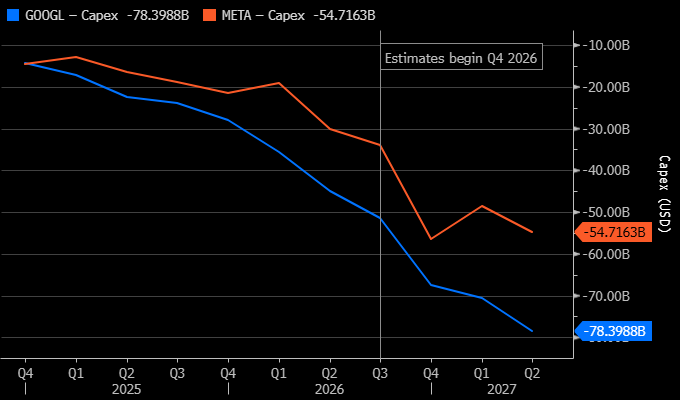
This may be a moment of truth for Alphabet. Either it fixes how the company monetises AI, or the giant risks losing leadership in several of its core businesses in the near future. Until Google shows it can charge for AI the way it once charged for search ads, every capital spending forecast will read as a drag.
A Trade in the Tale
How does Alphabet’s AI monetisation compare with, say, Meta’s? The narratives diverge.

The divergence reflects the different stages of each company’s AI monetisation journey. Meta’s ad revenue grew twice as fast as Alphabet’s in Q3, the former beating consensus while the latter missed. Both currently have similarly sized ad revenue pools, but are growing at different rates. Meta’s positive surprise stems from where AI sits in the monetisation chain.