

Occasionally, a story comes across your desk where the market reaction and the underlying economics seem to be telling two different stories.
Alibaba’s (BABA US, 9988 HK) $10.2 billion (HK$80 billion) share sale, Hong Kong’s biggest follow-on offering on record, is one of them.
Markets have immediately focused on dilution. Shares fell around 8% after the announcement, and criticism followed. Even Michael Burry, a now-native writer on Substack, announced that he had moved his entire Alibaba position in favour of JD.com, and said he would not be interested in Alibaba unless the share price were half what it is now. While Burry stated that he “cannot bless share issuance”, we contrastingly see this action as positive for Alibaba’s pursuit in the AI race and believe the investment, after some short-term pain, will be rewarded.
We are not here to rebut the opinion shared, but instead to highlight what the market is overlooking. Focus is too heavy on the shares issued and too light on what those shares buy Alibaba. The raise provides fuel for the AI buildout while preserving cash, limiting additional leverage, and retaining balance sheet flexibility for what could become an even more capital-intensive arms race.
We don’t often drill down into the micro details and publish a report on a single stock, but today readers can enjoy a different approach. A top-down overview of our bull case for Alibaba in the AI world, and a bottom-up analysis from contributor TacticzHazel, an independent equity investor and researcher.
For those interested in reading more of his work, AP Research readers can subscribe at a discounted rate here.
Preserving Debt Capacity
The major concern with share issuance is diluted earnings. That in turn hurts stock performance in the near term. It is a valid concern for an investor, but it does not, by itself, determine a company’s prospects. More has to be considered here.
Alibaba’s fundraising will help drive AI-led growth, and the impact on earnings will be limited if the company can improve AI payoffs. We see this raise as a bigger contributor to the AI “arms race” than the dilution itself.
Let’s start with the mechanics; after all, a few specifics never hurt anyone. The company issued 710 million new shares at HK$112.70, equivalent to roughly 3.6-3.7% of its enlarged share count, priced at an 8.4% discount to Friday’s HK close, with the proceeds earmarked for its full-stack AI capabilities. This creates a mathematical headwind for existing shareholders and was likely a contributing factor in Burry’s decision. Corresponding EPS dilution will be somewhere around 3.5%, but focusing purely on dilution risks missing another consideration:
Why equity? And why now?
Alibaba is hardly a distressed company scrambling for repairs. The balance sheet is strong, liquidity is ample, and in recent years the company has spent cash buying back stock, reducing share count by more than 11%. Switching tack towards issuing shortly after comes across as a slightly awkward capital-allocation approach. Retire equity, and then come to the market asking for more?
On the surface, it seems strange, but there is some logic to it. We would distinguish between needing capital and choosing how to finance growth. Alibaba sits in the latter camp. Financing options are abundant, and Alibaba is issuing equity so that they remain so.
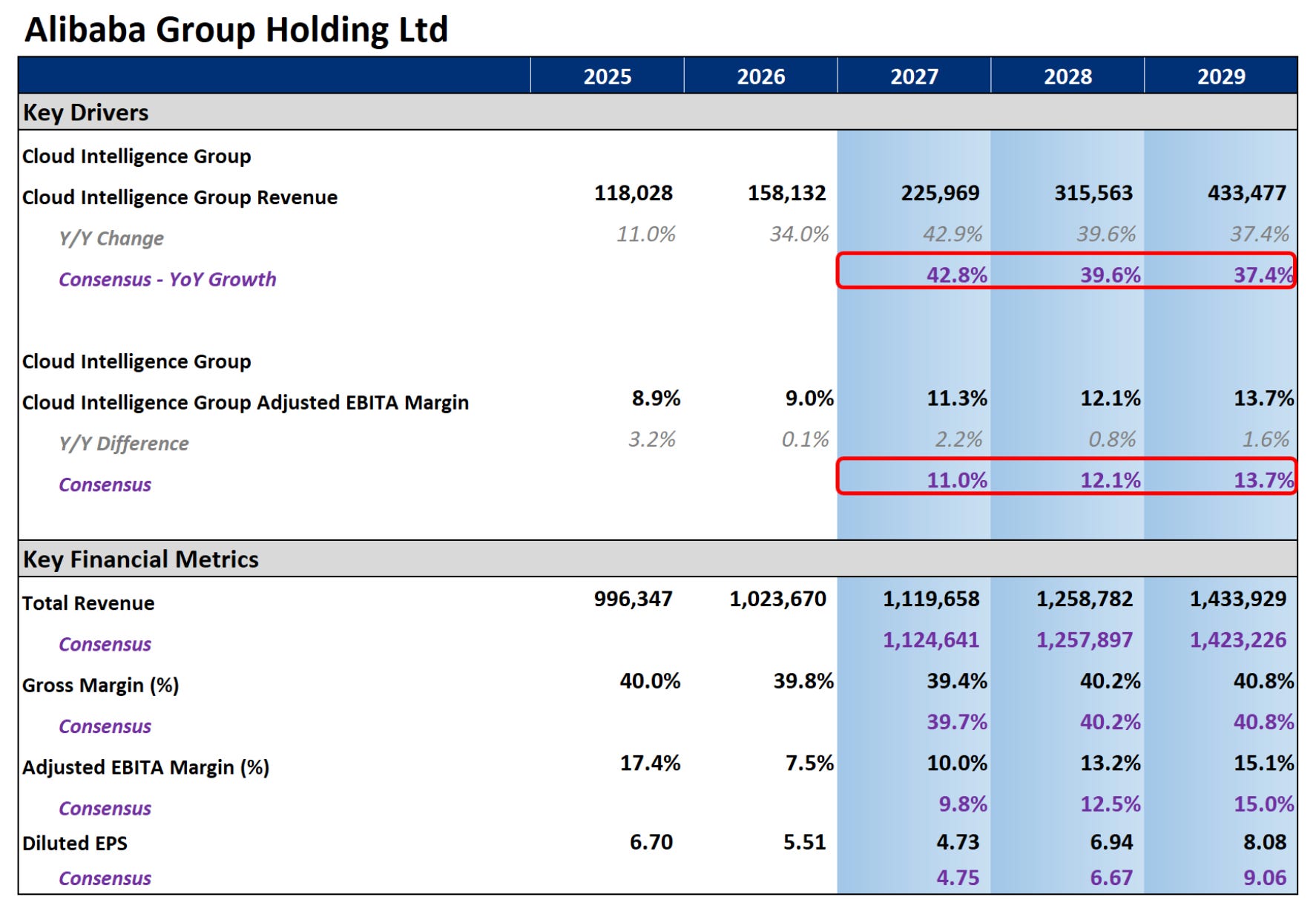
As with many big tech firms, there is little certainty about what the eventual tab will be for the AI buildout. That concern is as present with Alibaba as it is with the others. Estimates rise year on year. The management team’s original three-year infrastructure commitment was (¥)RMB380bn ($56.5bn), but it is already indicating expenditure could exceed this figure. In the last quarter, capital spending jumped 75% YoY to ¥68bn ($10.1bn), against ¥23bn of operating cash flow. Alibaba is a highly cash-generative company, but not sufficiently so to finance the AI buildout at the speed the management team currently wants.
Cash burn also appears to be partly elective. A foothold in AI development means cash must go out before revenues come in, and considerable amounts at that. Servers, chips, and data centres are financed today and rewarded tomorrow. Per Alibaba’s management, servers currently repay their cost within roughly three years, with a potential for that figure to fall towards two and a half, while carrying a depreciation life of five years. At current margins and payback periods, Alibaba could bring the AI-cloud and computing business back to positive cash flow if revenue growth were restrained below roughly 33%. Instead, the company is growing at 45%, allowing it to ease pressure off the accelerator, but choosing not to.
This lets Alibaba continue growing AI infrastructure at 40%-plus rates without forcing the balance sheet to absorb the entire gap between today’s capex and tomorrow’s cash generation.
Dilution at a Fair Price
The alternative funding method would have been tapping debt markets, as has been the predominant case with US Tech. This avoids dilution, but doesn’t avoid cost. 1-year dollar funding options would cost the company about 5.4%, while Dim Sum debt could be issued at a lower rate of 2.5%. However, this option was ruled out because of shallow market depth, an RMB-USD mismatch, and limited global investor reach.
Debt also introduces an obligation. Whether the investment pays off or not, the coupon payment remains, a concern we raised recently in our exploration of Nvidia’s new SPV and the risks to AI financing. Preserving debt capacity deserves more attention than a 3.5% EPS dilution. To us, the headlines and sentiment incorrectly emphasise the risks of this raise.
Alibaba’s balance sheet strength stands out compared with China and global peers. Equivalents of $70bn in cash and investments against $39bn of debt leave the company with considerable financial flexibility. Using equity maintains that balance sheet buffer, which we view as a much preferable approach than converting aggressive but discretionary AI investment into fixed claims on future cash flows.
Preserving this strength and borrowing capacity rather than stretching themselves in the opening stages of the race may prove fruitful. We have already mentioned that Alibaba has increased spending expectations, and these expectations will continue to rise as competitors do their best to keep moving forward. Tencent and Baidu face exactly the same incentives: as one participant raises the stakes, the others must decide whether to follow.
Of course, if Alibaba spends tens, maybe even hundreds, of billions building capacity that customers do not sufficiently value, issuing shares rather than debt makes the economic outcome no different. But if you take the side that AI investment pays off, then Alibaba has limited any risks relating to a financing problem as well. For this, we value the recent decisions and see this as an opportunity to increase exposure.
On the economics, evidence suggests the underlying business is already better than the headline. The company disclosed ¥5.6bn of adjusted EBITDA from cloud computing in the latest quarter, at a margin close to 12%, while revenue grew by 45% in this period. With the server economics repaying costs in a two-and-a-half- to three-year period, as stated previously, against a five-year useful life, this implies a project-level internal rate of return of around 20-30%. Cloud revenue has also accelerated for nine consecutive quarters and just recorded its fastest growth rate in 22 quarters. If these numbers hold, a 3.5% dilution looks fairly minimal.
In an AI race where the distance is yet to be disclosed, keeping some fuel in reserve seems prudent.
Bottom-Up Analysis
Underneath the hood, Alibaba is executing well, but by no means fantastic. To draw that conclusion, we first have to understand what Alibaba is all about. Most investors still know Alibaba mainly as an e-commerce giant. While that is still true for most of its earnings, it transcended that basic premise long ago.
The best way to look at the company is to divide it into three segments. First, there were: China e-commerce, International commerce, and Cloud Intelligence.
But as of this quarter, Alibaba has started reporting its business in a different way, one that makes more sense looking ahead and where they want to end up in a decade’s time.
The new segments are:
Alibaba E-commerce Group
AI Cloud and Compute Services
AI Labs and Applications
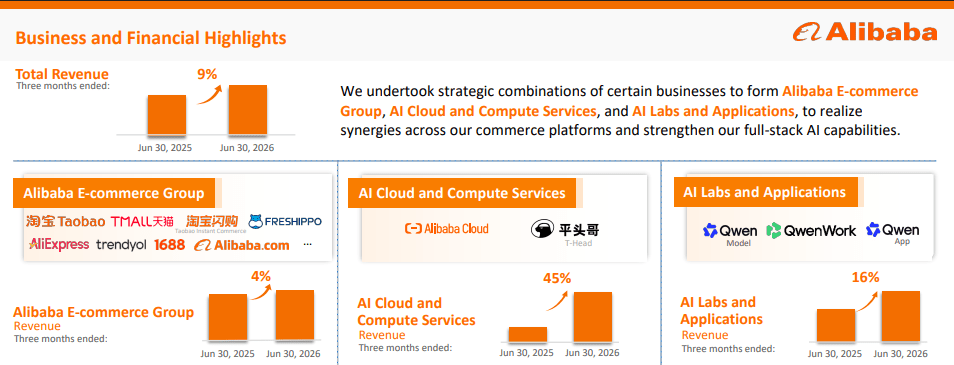
Alibaba Health, Amap, Lingxi Games, and the media assets are categorised in the “all others” segment.
One thing that stands out is that this “reorganisation” doesn’t clearly improve investors’ view of the company. They actually separated the model labs and consumer AI apps into their own segment.
And by doing so, they exposed the losses clearly to everyone. Instead of hiding it, management showed transparency and brought the Qwen app spending into the open.
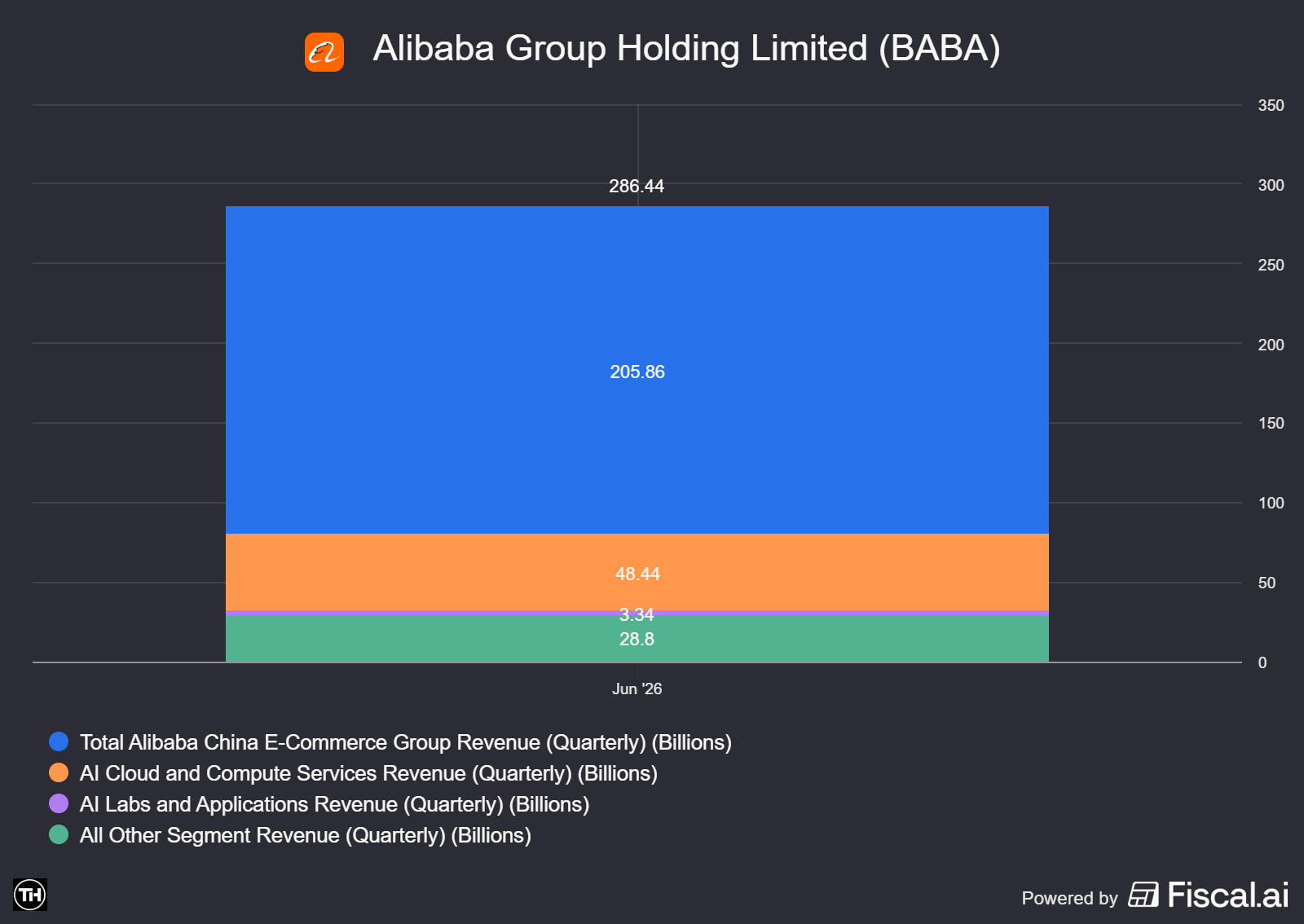
As you can see, the E-commerce section is still responsible for the vast majority of revenue. 71.7%, so almost three-quarters of revenue still comes from E-commerce. But that is not the growth story.
Alibaba E-commerce Group
We think the best way to view this segment is as a “cash cow,” funding growth in the other segments. Revenue grew only 4%, and adjusted EBITA fell 0.6%. These numbers are underwhelming, and they are not why one would invest in Alibaba right now.

Today, this is by far the most profitable segment, with group-wide adjusted EBITA of RMB27.3bn. E-commerce produced RMB39.7bn. Cloud added RMB5.6bn, but the other segments were unprofitable overall.
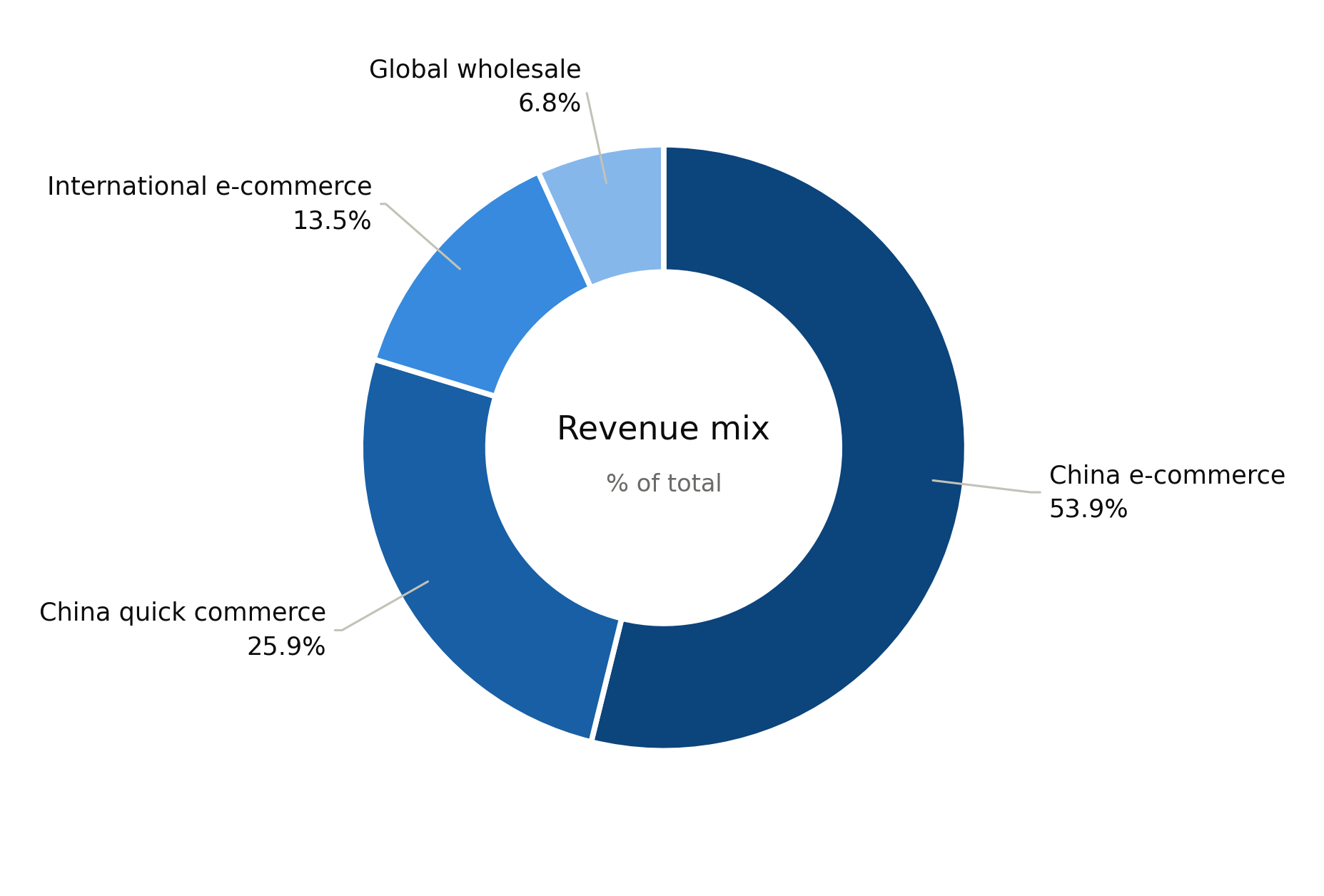
China E-commerce, which is responsible for over 50% of this segment, fell 8%. Management claimed this was due to weak transaction activity and a soft customer base, a headwind they’ve flagged multiple times in the past quarters. It’s clear that the China E-commerce engine is facing weaker transaction activity and a soft macro environment.
Meanwhile, the China Quick Commerce segment grew 45% YoY. In this segment, you can find Taobao Instant Commerce, Freshippo, and on-demand grocery delivery. Losses in this segment narrowed this quarter, which is actually quite impressive given how fast it scales right now.
International e-commerce was roughly flat YoY, down about 1%. This is mostly because of geopolitical headwinds and the tariffs. A big milestone to be celebrated here, with AliExpress finally being profitable after years of draining cash to fund growth.
Global wholesale, the smallest segment, rose 7% YoY. In this segment is Accio Work, an AI agent built specifically for cross-border merchants. Accio reached over 50k paying merchants shortly after launch.
Looking ahead, management believes quick commerce should become profitable in FY29, and in the long term, they think it will contribute 30% of platform GMV.
A simple conclusion can be drawn: the legacy marketplace is now a cash machine, under pressure from a weak Chinese consumer, but this is where funding for the other business lines starts.
AI Cloud and Compute Services
If there’s one thing to get excited about with Alibaba, it’s the AI cloud and Compute segment. External revenue growth accelerated for the last nine quarters, and in Q2, YoY growth was 45%. Alibaba Cloud margins improved to 11.6%. And if this cloud thing is new to you, growth and margin expansion are very unusual in this line of business.
The key driver here is AI product revenue. It’s unclear what this exactly entails, but Wu recently said it’s mostly AI compute, MaaS (Model-as-a-Service through Bailian / Model Studio), and AI applications and software. Qwen is NOT in here; more on that later.
AI product revenue saw triple-digit growth for the twelfth consecutive quarter. As of the latest quarter, that makes up about 35% of external cloud revenue, up from 30% last quarter. So it’s starting to continue significantly more and more to headline numbers
This also explains why margins were up, as these products carry much higher margins than the rest of the cloud portfolio.
Everyone knows compute is scarce right now, and consensus is that this will remain true until at least 2030. This pushes GPU pricing toward the most profitable monetisation model.
Alibaba claimed that it actually renewed its contracts at a better price than when they initially signed them. So for them, compute is no longer just a cost factor; it’s now more of a revenue-linked asset. CFO Toby Xu said that Alibaba runs servers for five years, and that AI servers cover their cost in three, so years four and five are free cash flow. Utilisation rates for their older GPUs also seem very high. An A100 bought in 2020, or a V100 bought in 2018, is still running at full capacity today. This basically tells us that the useful life runs well past the accounting depreciation schedule.
Another important addition to this segment is T-head, a chip designer. They have already shipped over 500k previous-generation chips.
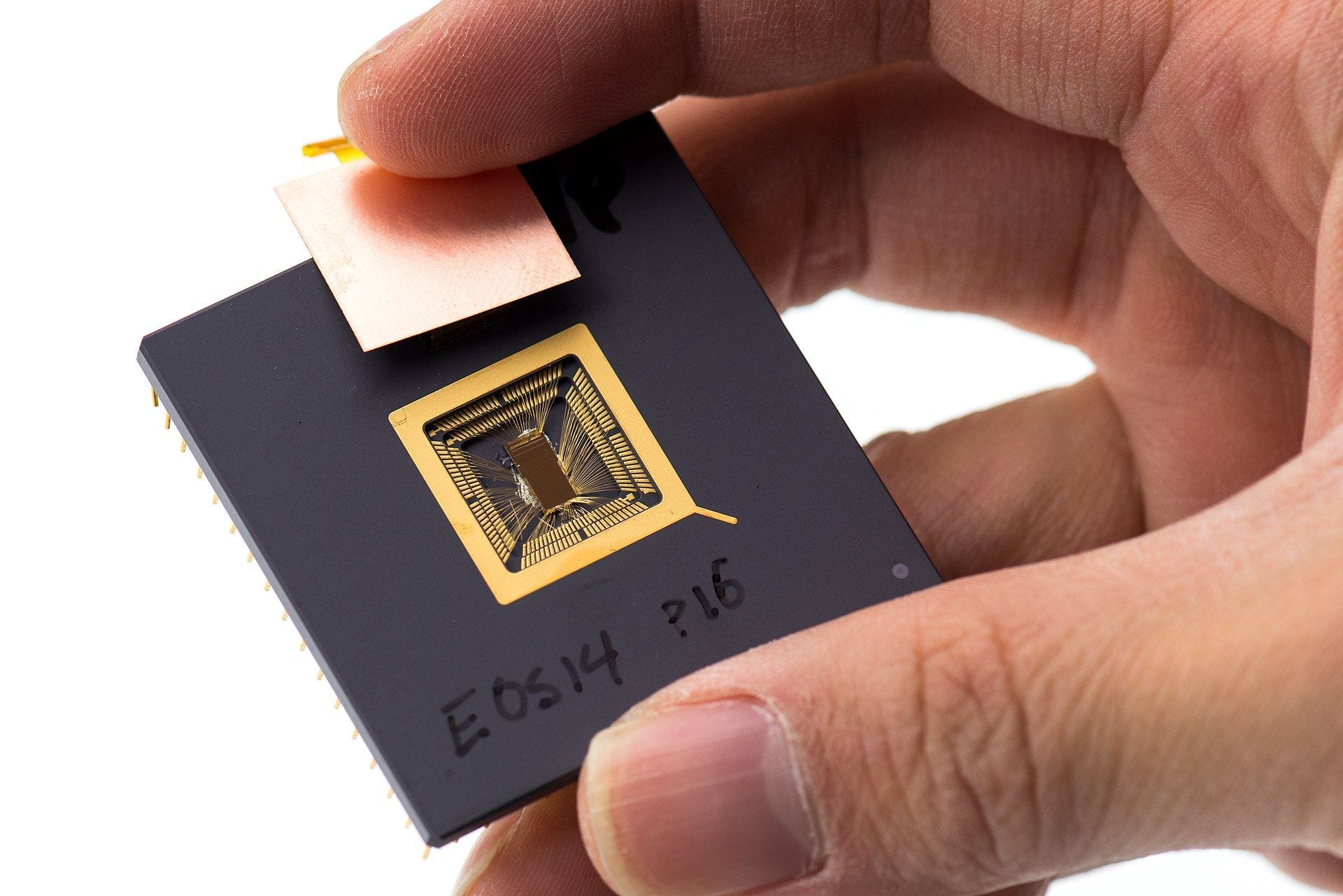
Their latest new Zhenwu M890 went live on Alibaba Cloud as a SuperNode instance in August. It runs inference for models above two trillion parameters.
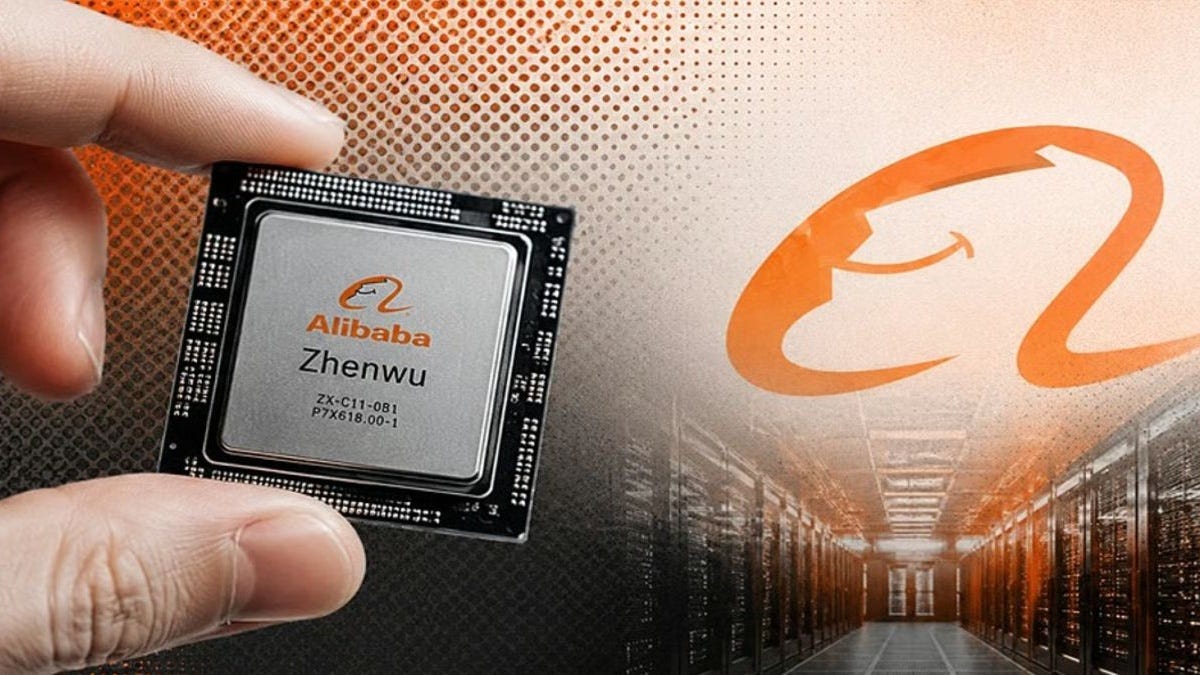
As you are probably aware, this is quite a big deal. Chips and storage are the most important parts in an AI data centre, and commercial GPU’s are very expensive right now. So every little percentage point they can squeeze out of their own chips flows straight to their gross margin.
Alibaba’s ambition here isn’t small; they want to do over $100B in external cloud revenue by 2030, preferably with gross margins of 20%. Management stated that they have “good visibility” on both. This means that growth should accelerate further in the next quarters, with EBITA margins expanding on top of it. But doing $100b in 2030 implies a 45% CAGR, which seems extremely aggressive to us.
Alibaba seems well positioned to capture a large share of the cloud market in China, and it’s safe to conclude that this part of the business is likely the most important growth lever to pull in the next few years.
Any meaningful slowdown here will certainly put the eyes back on the e-commerce section, and that’s not what will get investors anywhere close to excited.
Last but not least, the AI Labs and Applications section.
AI Labs and Applications
This is where things start to hurt, as this is the opposite of a cash cow. AI Labs and Applications show an adjusted EBITA loss of RMB13.9bn, against a RMB3.2bn loss a year ago. When you look at the headline numbers, this segment delivers much of the pain.
So what is causing the pain exactly? AI Model Labs, the Qwen app itself, and QwenWork, which is their new enterprise agent. Like other AI model builders, a large chunk of the losses come from training and inference costs. This also applies to the Qwen app. Luckily, the loss narrowed significantly this quarter because marketing spend came down. Management believes this downward trend should continue as marketing normalises and training efficiency improves.
An important distinction to make here is that the money that’s being spent in this segment shows up as revenue somewhere else. Think of the MaaS revenue, API calls, inference, etc. They are all booked into the cloud segment.
So why the focus on open-source models rather than closed models like OpenAI? Wu’s argument is that a growing, open ecosystem drives more demand for compute. And would you know, Alibaba sells compute. He also said gross margins on hosting third-party open models are roughly the same as hosting Qwen. More open models on Bailian is good for Alibaba either way.
Now we are full circle. This is where the connection to the E-commerce platform starts coming through. Over 250M users have used Qwen’s agent to do shopping.
While the share offering rightfully spooked investors, insiders opened their wallets. Alibaba Group co-founder Jack Ma has joined a pair of senior executives in picking up over $100M in shares in support of Alibaba’s AI ambitions. Jack Ma bought more than HK$600 million (S$97 million) worth of shares. This is on top of the US$20 million (S$25.4 million) worth of stock that senior execs Joe Tsai and Eddie Wu had together acquired in recent days.
And we all know the saying: “Insiders only buy for one reason.”
Our Take
Betting on Alibaba is not simply a bet on its e-commerce business. It’s the belief that the cloud and AI segments will drive growth over the next few years.
But to facilitate that growth, management has to continue spending a lot of cash. Capex jumped from RMB38.7bn to RMB67.7bn, taking cumulative spend to RMB190bn of the RMB380bn three-year plan.

While the ROI on these investments remains unclear for now, this seems to be the way forward, especially given where Alibaba’s core business stands today. This is where it will build its growth engine for the next decade.
Wu received the simple question in an earnings call: where does value end up in the AI stack?
He answered that right now, nobody knows; the short-term is concentrated in chips and infrastructure. But Alibaba built all four layers precisely so the answer doesn’t have to matter. They are spreading their bets, ready to make the move when the time is right.
The large increase in capex and the latest $10.2bn share sales are what it costs to place the bet.
The bet on the future.
AP, TH
Disclaimer: both AP Research and TacticzHazel have a position in Alibaba (BABA US).
This article was written in collaboration with TacticzHazel. TacticzHazel is an Independent equity investor and researcher. He focuses on high-quality companies with moats and strong balance sheets. If you enjoy sector deep dives, company research and other investment ideas, you will enjoy his work.
We had a great time writing this piece together as our styles and research approach overlap a lot. We’d highly recommend subscribing to his newsletter via the link below.
Well, hopefully Baba will stop burning cash to compete for the instant food delivery business with JD.com and MEITUAN soon. Basically it subsidizes customers to order on its platform, while asking shareholders for paying AI bills :)