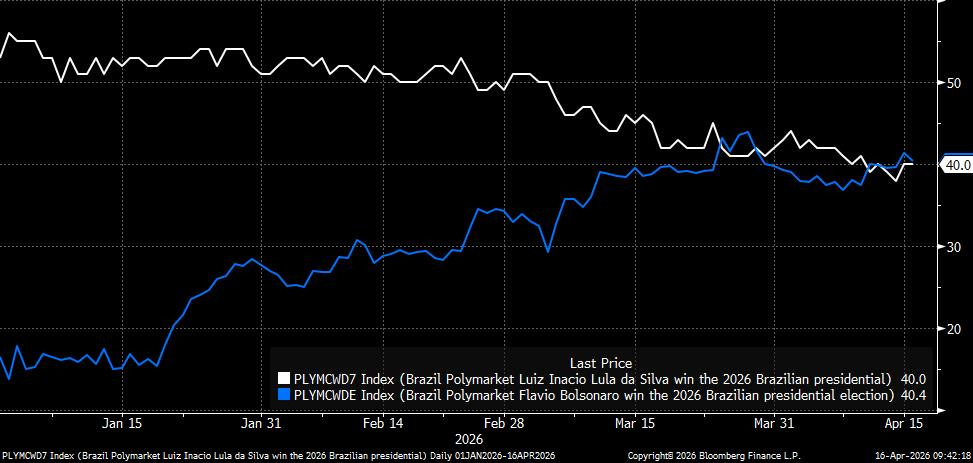
Global markets were busy dealing with the situation in the Middle East for much of Q1. This overshadowed events in Brazil, where a combination of early positioning ahead of the elections in the autumn, an energy-driven export tailwind and a continuing carry appeal in FX provided some with healthy gains across various Brazilian assets.
We turn to Brazil as one of our favourite places to allocate capital in the emerging market space right now. For some of the thematic drivers, like carry, the consensus framing is relatively simple and attractive. Yet for other narratives (that a shift to a right-wing regime under junior Bolsonaro would be a large positive), the picture is more nuanced.
Below, we outline our outlook on Brazilian politics, energy, interest rates, and broader cross-asset dynamics, alongside actionable trade ideas. Consider this a structured guide through one of the more compelling opportunities in emerging markets, best read with a caipirinha in hand.
SUMMARY
We believe that Brazil has the potential to outperform both at an absolute and relative level this year, based on three strands of reasoning:
A Lula continuity victory could be taken as a better outcome than a right-wing regime change. Lula is not fighting Jair Bolsonaro, but rather his unproven son, who risks alienating voters from better right-wing candidates.
The net energy export status provides beneficial terms of trade, boosting related domestic equities and providing a tailwind for continued BRL appreciation.
Elevated interest rates will continue to satisfy yield-hungry investors, especially when paired with low-yielding currencies like JPY, which is likely to remain under pressure throughout this year. The potential for an energy-driven inflation shock further reduces the likelihood of any material easing from the BCB.
Continuity Over Convexity
A BTG Pactual/Nexus poll published at the end of March showed Brazil’s President Lula da Silva and Senator Flavio Bolsonaro tied at 46% in a potential run-off in the October elections. When you consider that Bolsonaro only entered the race in December and had an assigned probability of winning of 15% in the middle of January, the poll highlighted a trend that had gone under the radar for much of Q1, namely that Bolsonaro is now seen as the main challenger to Lula.