

Wall Street is never short of new ideas. More specifically, Wall Street is never short of new financing ideas. The track record of finding new assets to collateralise a finance deal goes back more than a century. Railways, mortgages, aircraft, music royalties, even cheese. This latest chapter in financing in this new AI era, aptly, is GPUs.
News broke last night of Nvidia’s new initiative (in partnership with US investment giants Apollo, Blackstone, BlackRock, Brookfield, Goldman Sachs, and KKR) to source financing for artificial intelligence, mobilising $500bn of third-party capital for AI infrastructure.
To break it down to its simplest explanation, (1) create a special-purpose financial vehicle that can issue debt or bonds, (2) use the proceeds of this issuance to buy GPUs and compute infrastructure, (3) then lease these assets and capacity to customers.
So far, the AI buildout has required huge upfront capital to build assets whose economic value is derived from renting out compute. But some good old-fashioned financial engineering never stood in the way of closing a gap before, and is set to do the same this time around. Now, the owner of the GPUs no longer needs to be the financer of it.
CoreWeave has already done something similar. An $8.5bn non-recourse facility is secured against AI infrastructure and customer contracts, while Apollo has also financed a vehicle to acquire $5.4bn of Nvidia’s equipment and lease it to xAI, Musk’s AI house.
However, financial innovation can change the question that needs to be asked. Peter Drucker once said, “The most serious mistakes are not being made as a result of wrong answers. The true dangerous thing is asking the wrong question.”
There is no point questioning demand for Nvidia GPUs. Quarterly calls from the company answer that question without doubt. However, one question hangs over us: Would the demand be equivalent if the financing available to these buyers were any different? Attractive financing can bring demand forward, but it also blurs the lines as to whether that timeline change is demand-led or financing-led.
Per Stanford’s research:
“The cost of querying an AI model that scores the equivalent of GPT-3.5 (64.8) on MMLU (a popular benchmark for assessing language model performance) dropped from $20.00 per million tokens in November 2022 to just $0.07 by October 2024 (Gemini-1.5-Flash-8B), a more than 280-fold reduction in approximately 18 months.”
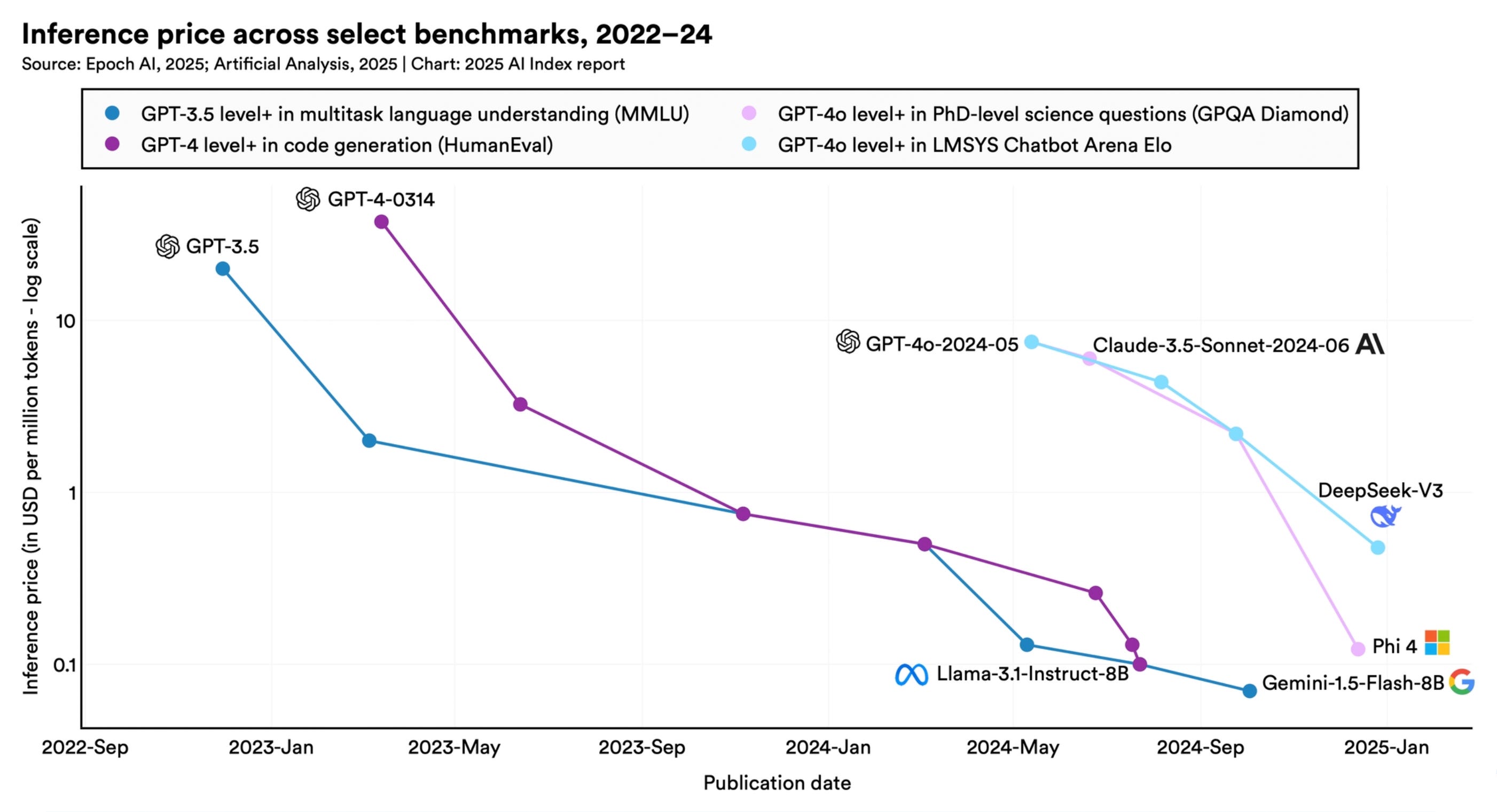
Applying this to our economics, a lender may currently be financing multi-year debt against assets whose economic usefulness can be repriced significantly over a relatively short period (18 months, as the example above illustrates). This is the point that takes us to the juice of this thought exercise.
The bear case for AI investment need not be that AI falls short of current expectations and brings no ROI, that revenues are fictitious, or that GPUs sit unused. History tells us that technological shifts produce real assets and real cash flows, while still generating financial excess along the way.
Take a look at how the chain plays out.
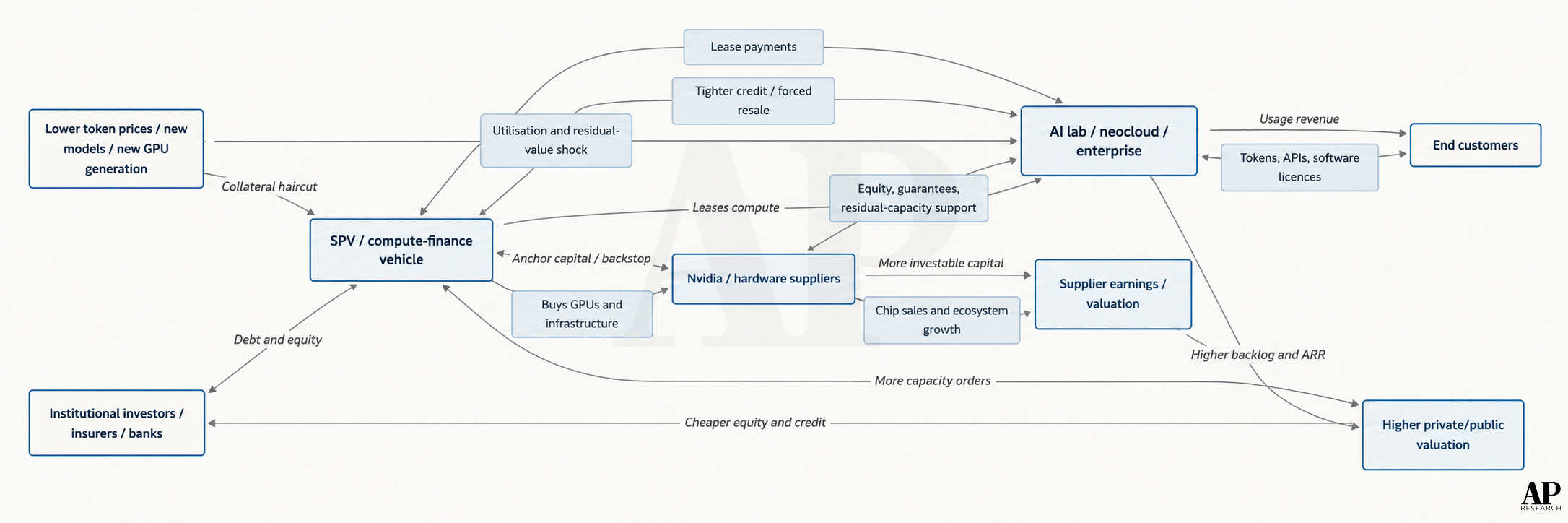
Cheap financing means more deployed compute. More deployments create more chip sales and demand backlogs. That validates higher valuations. And higher valuations mean more equity and credit available. Nothing in this circularity needs to be fraudulent to bring it down. Reflexivity can do enough on its own to cause a crash (the core of our stress test to end this article).
The circular nature of such transactions has raised concerns about concentrated risks in the sector. We raised this initially in our autopsy of the recent AI selloff, citing the three Cs as factors driving the AI trade, be it higher or lower. Capex (or we could call this C “circularity”) deserves a note of its own.
C For “Circularity”
Circular financing is a business arrangement where a supplier or investor funds a customer, and that customer uses the money to buy products or services from that same supplier. The cash moves in a loop: money goes out as an investment and comes back as reported revenue.
Several high-profile examples illustrate the depth of these interconnections.
Microsoft and OpenAI: Microsoft has invested $13.8bn in OpenAI and now holds 27% of its for-profit entity. In return, OpenAI has agreed to purchase up to $250bn of Azure cloud capacity through 2032.
Amazon, Anthropic, Microsoft, and Nvidia: Amazon has now committed up to $8bn to Anthropic and remains its primary cloud and training partner via Amazon Web Services (AWS). More recently, Microsoft and Nvidia have agreed to invest up to $15bn ($5bn from Microsoft and $10bn from Nvidia), while Anthropic commits to purchase $30bn of Azure compute over the coming years, running on Nvidia systems.
xAI and Nvidia: Elon Musk’s xAI is structuring a $20bn special-purpose vehicle that will buy Nvidia GPUs and lease them back to xAI. Nvidia is reportedly contributing $2bn of equity for the same vehicle, while also supplying the hardware, effectively financing a portion of its own future sales.
This new deal takes circularity one step further, although Jensen Huang might disagree.
Much of Nvidia’s ecosystem has been direct as described above. Relationships stay between Nvidia and their customers. Whereas this new arrangement allows Wall Street to take a seat between the two. Rather than Nvidia taking exposure directly to the operator, and, indirectly, to its own GPUs, this SPV owns a broader layer of AI infrastructure and can raise different layers of capital against it. A financing stack, so to speak.
Equity sits at the bottom, absorbing the losses first but gaining much of any upside. One layer up sits private credit or mezzanine debt, gaining a higher return for more risk. Senior debt sits at the top level, gets paid first, and therefore remains the most protected.
It’s all very similar to how Wall Street has performed for its existence. Take risky cash flow and divide the losses among investors willing to bear the most risk. Nothing is inherently troubling about this structure, as, for one, it’s common practice on the Street. Uncertainty and unknowns are the risk.
A larger pooled SPV can diversify both the counterparty and the assets, so the risk attached to each dollar of financing falls. It also means that the total number of financed dollars can rise. Yes, the SPV does what it was intended to do, but increased capital efficiency during an investment boom can extend the investment boom. The buildout has transitioned from Big Tech’s balance sheets (strong after years of high FCF) to debt, private credit, new SPVs, and a need for supplier support (circularity).
The bullish takeaway is that the opportunity has become too large for traditional financing channels. Maybe the bearish spin is that the capital required to maintain the current rate of change has become too large for traditional financing channels. The balance between the two is left to the eye of the (risk) beholder.
The development of this new financing is a natural evolution of the industry, but changes the nature of the investment cycle.
Collateral GPUs
One question to ask relates to the collateral. In the intro of this article, we mentioned the use of collateral such as railways and aircraft. There are reasons as to why these were attractive. Economic value persists for decades once they are built. The operator can fail while the asset is still viable, which is where the use of GPUs differs from traditional infrastructure.
There is no question about their value today, but it can be difficult to calculate their useful or economic life when that may differ significantly from their physical life. A GPU may still be functional even as the value of the computing power it creates falls sharply. Nvidia is effectively paid to exacerbate this problem. Blackwell chips are on offer while Jensen boasts of how substantial Rubin is in comparison. It doesn’t take a genius to figure out that Rubin, in time, will also be superseded. The relentless improvement is what equity investors want from the company, and why they have been rewarded handsomely so far. But it remains somewhat of a puzzle what a lender wants from that same asset that supports a multi-year loan.
Therefore, a creditor financing a GPU is underwriting much more than whether a chip remains operational. Important questions remain as to the future earnings power.
What utilisation rate will hardware achieve in the years to come?
How quickly will inference costs fall?
Could workloads migrate towards Google TPUs, custom silicon, or future technology that does not currently exist?
And what would today’s GPUs fetch in the secondary market if the borrower fails during the life of the loan?
For example, CoreWeave’s GPU-backed financing extends to 2032. The asset securing that borrowing needs to retain sufficient economic value through several generations of hardware development. Nvidia’s new SPV approach does improve this problem marginally, as the collateral is not made up entirely of GPUs. Other areas of the infrastructure stack (cooling, networking, power) will also be used. Much like the railway comparison, a power connection could be released to another operator as the useful life will remain well past the length of the loan.
There is also a limit on what good diversification does here. An SPV with exposure to ten different operators is safer than one with exposure to one, of course. One management mistake or one customer failure causes significant damage without that diversification. However, many plausible problems can arise that are not common to one entity but are instead sector-specific. These risks are prevalent and well documented regarding AI, and lie in the basket of “What Ifs?”
What if AI applications take longer to generate revenues than currently assumed? Utilisation and rental pricing would come under pressure across the sector. The diversification protection disappears as every borrower owns the same exposure, the value of scarce compute. Ten names do not provide protection if all ten face the same stress.
The same issue applies to the claim that GPUs are liquid collateral. Under normal conditions, they likely are. If one borrower needs to sell a fleet of accelerators while demand for capacity remains high, there is plenty of demand for that supply. Yet liquidity is always easiest to demonstrate when nobody needs it. If several heavily financed operators simultaneously discover that they own more compute than they can profitably rent, the secondary market would have to absorb that supply as expectations for the earning power of that hardware deteriorate.
The risk of GPUs as collateral is that the recoverable value is much more cyclical than the current price surge suggests.
The Stress Test
Let’s wrap this all up in a stress test, not an AI doomsday one, just a scenario with some adjusted assumptions.