

An early rebound in equities, fueled by enthusiasm over Anthropic’s S-1, reversed as Big Tech earnings highlighted cash-burn concerns. The Nasdaq entered a technical correction by Friday’s close. Investors are now asking whether this marks the start of something worse or a recurring signal to buy the dip.
Starting with the good, Anthropic’s S-1 filing on Monday showed $16.3bn of revenue in the first half and lifted the semiconductor stocks about 3% on Monday and 3.6% on Tuesday, as investors priced in a new, cash-rich buyer of computing power. Yet for tech, Alphabet’s worst day since 2004 ($500bn wiped), Intel’s warning that memory prices are choking PC demand, and Amazon’s trailing 12-month cash outflow of $42.4bn left the market with little to enjoy over the weekend.
403 names rose on Thursday as the S&P 500 index lost 0.3%. The heaviest names, which drove returns for most of the last few years, are now seeing that dynamic play out in the opposite direction. Healthcare (+3.1%), Materials (+2.0%), and Utilities (+2.0%) led, while Communication Services (-8.5%) and Information Technology (-1.8%) lagged.
Tech was not the only takeaway from a macro-heavy week. The Fed offered some support after holding rates at 3.75%-4.00% in a 10-2 vote. Chair Kevin Warsh tied the recent wobble in AI stocks partly to September’s hike, saying the Fed’s “monetary medicine is starting to work some.” Bond traders took the hint, with the 2-year Treasury yield falling 10 basis points on Thursday as rate-hike expectations eased, even as third-quarter GDP beat estimates.
Over in Europe, the ECB held rates, with President Lagarde downplaying the risk of energy-driven inflation broadening into the wider economy. Markets are now pricing a third and final hike for December. And finally, UK Chancellor John Healey delivered a low-key budget, raising £6.6bn in net new revenue by 2030-31 while avoiding the sweeping tax hikes of his predecessor.
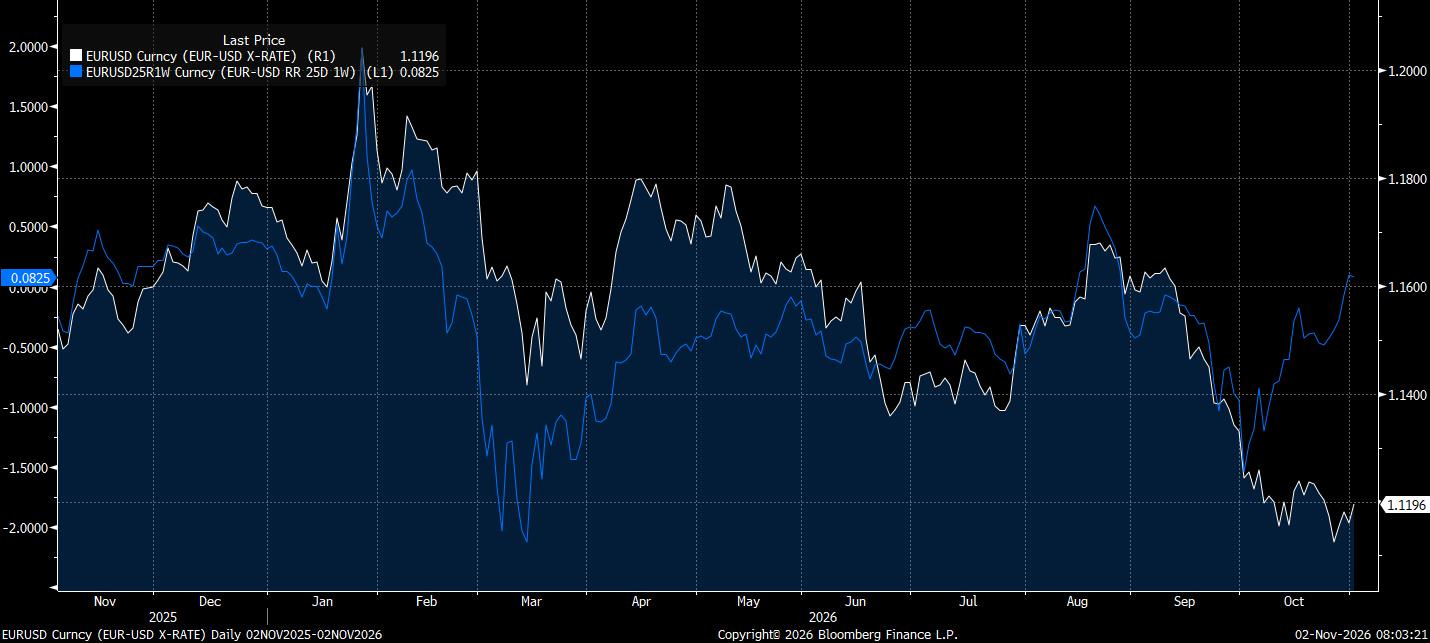
The dollar’s strength remains more selective than DXY would suggest. Much like last week, the greenback gained ground against the euro while the yen attracted haven demand whenever the AI trade came under pressure. EUR/USD touched a 17-month low of 1.1105 on Thursday. Given the currency accounts for more than half of DXY, euro weakness has done much of the heavy lifting for the dollar index.
Elsewhere, USD/JPY fell to 157.12 on Friday despite the BoJ holding rates, tracking lower Treasury yields. However, an interesting divergence is developing beneath the surface. One-week EUR/USD risk reversals turned positive for the first time in two months, suggesting options traders are beginning to question how much further the euro can fall. Spot continues to price in weakness, but the options market is paying for a rebound.
That’s enough of what was. The week ahead will deal with tech in the spotlight, US midterm elections, and the Treasury QRA. Let’s get into the guide to trades moving markets, where things stand, and where they may be heading.
“Clearing Event into Midterms”
“The Treasury QRA”