

“Qui paie ses dettes s’enrichit.” The old French saying is that he who pays his debts grows rich, but until recently, paying debts seemed to take a back seat to growing rich off politics. France has rarely been out of the political spotlight since the start of the current government, which has hardly helped President Macron. Although the 2027 election is still months away, assets are already showing concern tied to a growing unease within France itself. It’s getting harder to distinguish between the political problem and the fiscal one.
This dynamic traces back to the summer of 2024, when Macron suffered a crushing defeat in the presidential election to Marine Le Pen and her far-right National Rally, prompting Him to call a snap election in the hope of clarifying French politics and restoring his standing. But instead of providing clarity, the election destroyed the parliamentary logic that was allowing normal governance to proceed.
True, the snap vote did stop National Rally from taking control of France’s already precarious finances, but that was nearly all it achieved. A left-wing coalition finished with the most seats in the National Assembly; Macron’s centrist bloc survived the new political landscape with more legislative backing than one might have expected given his personal defeat, and Le Pen emerged as the biggest single political force in the country. But no party managed to seize the 289 seats needed for an outright majority, leaving the entire country effectively split three ways.
Stopping one party had made it nearly impossible for anyone else to govern.
For the last year, this period of prolonged parliamentary improvisation was characterised by a succession of prime ministers: Michel Barnier, François Bayrou, and, most recently, Sébastien Lecornu. The first two fell after each tried to repair France’s public finances, with Barnier lasting just 3 months in office, and Bayrou slightly longer, for 9 months. That it was necessary to appoint Lecornu for a fourth time just four days after he resigned shows the pretty desperate state of affairs within France. He survived largely becuase the moderate left conceded that extracting concessions from a weak government was preferable to bringing the whole thing down.
France has rivalled its arch-rival, the UK, in the political circus stakes.
But now the Lecornu minority government and its centrist allies have been plunged into its most treacherous season yet as opposition parties dig in over deficit-cutting plans designed to calm both the bond market and most of France’s disastrous finances. This all comes at an awkward juncture with a presidential election due in April-May 2027.
Ever since the Macron government faced a hung parliament following the June 2024 vote, it has tried, and largely succeeded, in using Article 49.31 to force its proposed budgets through without debate, much less a vote. It is true that the opposition may respond with a no-confidence motion, which would force the government to either make concessions to pass its budgets or accept collapse. Yet there is little appetite to compromise at a time when opposition parties are positioning themselves for the 2027 presidential race.
The risk is that it would become impossible to agree on a full budget for the second half of 2027 as the next president dissolves parliament and calls new elections at some point while work was beginning on the 2028 budget. Such a rollover would cause unprecedented budget paralysis, freezing investment and planned defence-spending increases while welfare costs keep climbing. That would widen the deficit by at least half a percentage point, denting investor confidence further and pushing up borrowing costs.
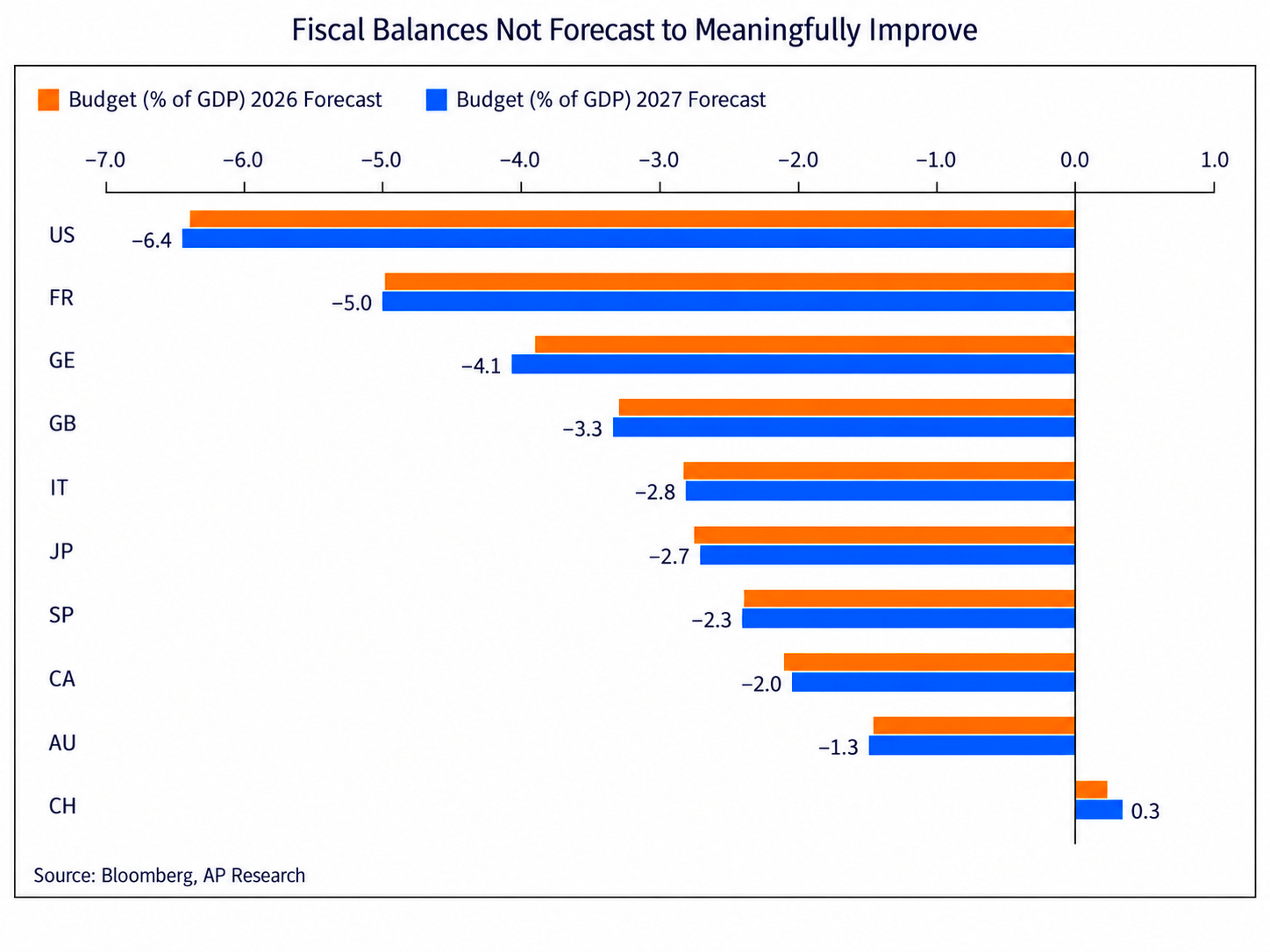
Public debt in France stands at 117% of gross domestic product, expected to rise to 121% by 2027, to be among the largest in the euro area. Behind the US, France also runs the largest deficits, without any forecast that this is set to change soon. The International Monetary Fund (IMF) projects a 2026 deficit of 5.2% of GDP versus a budget target of 5.0%. A series of proposals for fiscal consolidation now being debated in parliament are politically dangerous at a time when candidates are fighting for dominance in the heartland of Blue France.
La Toile de Fond (The Backdrop)
Early indications are that President Macron’s final finance bill may be the most perilous of his presidency so far.
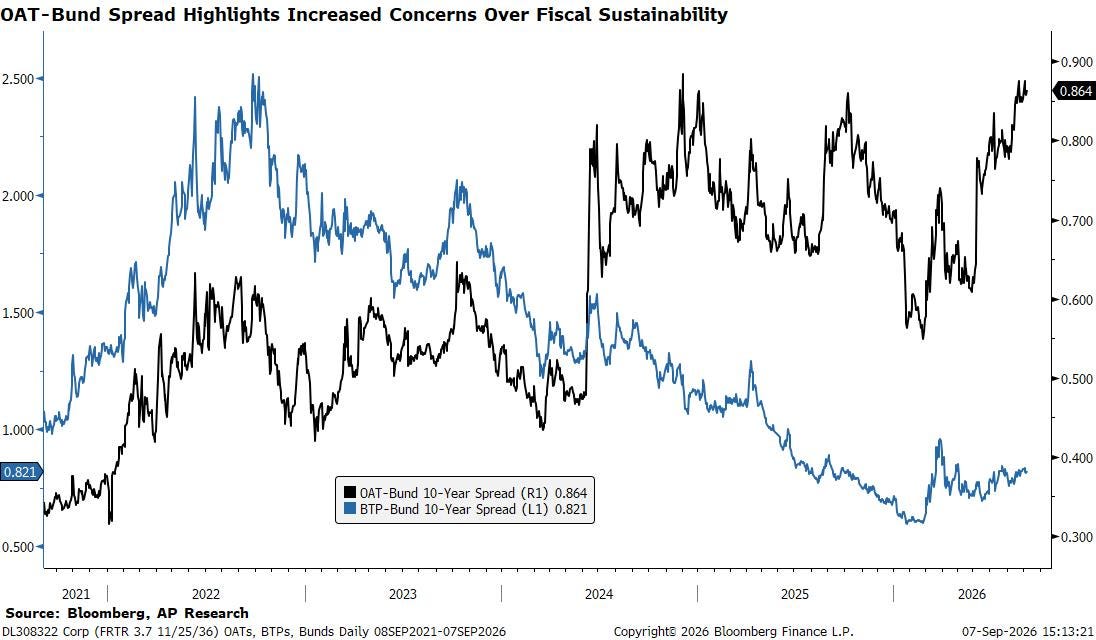
The excess that France pays to borrow money over German bonds (a key barometer of investor mood) is near its highest level since the sovereign debt crisis of 2012. Political and fiscal worries always manifest first in debt markets.
France has had no shortage of problems, but the first presidential debate was consumed by bickering over how best to deal with rising debt. In particular, there was robust dispute over a far-left proposal to cancel a portion of debt.
The on-stage questioning gave the far-right and far-left candidates a chance to stress-test unorthodox ideas. The leading far-right and far-left candidates, Marine Le Pen and Jean-Luc Mélenchon, have vexed senior business leaders in the past with disruptive propositions and have seen their repeated runs for president fall short of victory.
After three hours of hard-hitting probes, the contenders agreed only on the need to narrow the runaway budget deficit as a matter of urgency. The options ranged from clawing back welfare spending to hiking taxes, raising the retirement age, juicing the economy with more spending, or even cutting payments to the European Union.
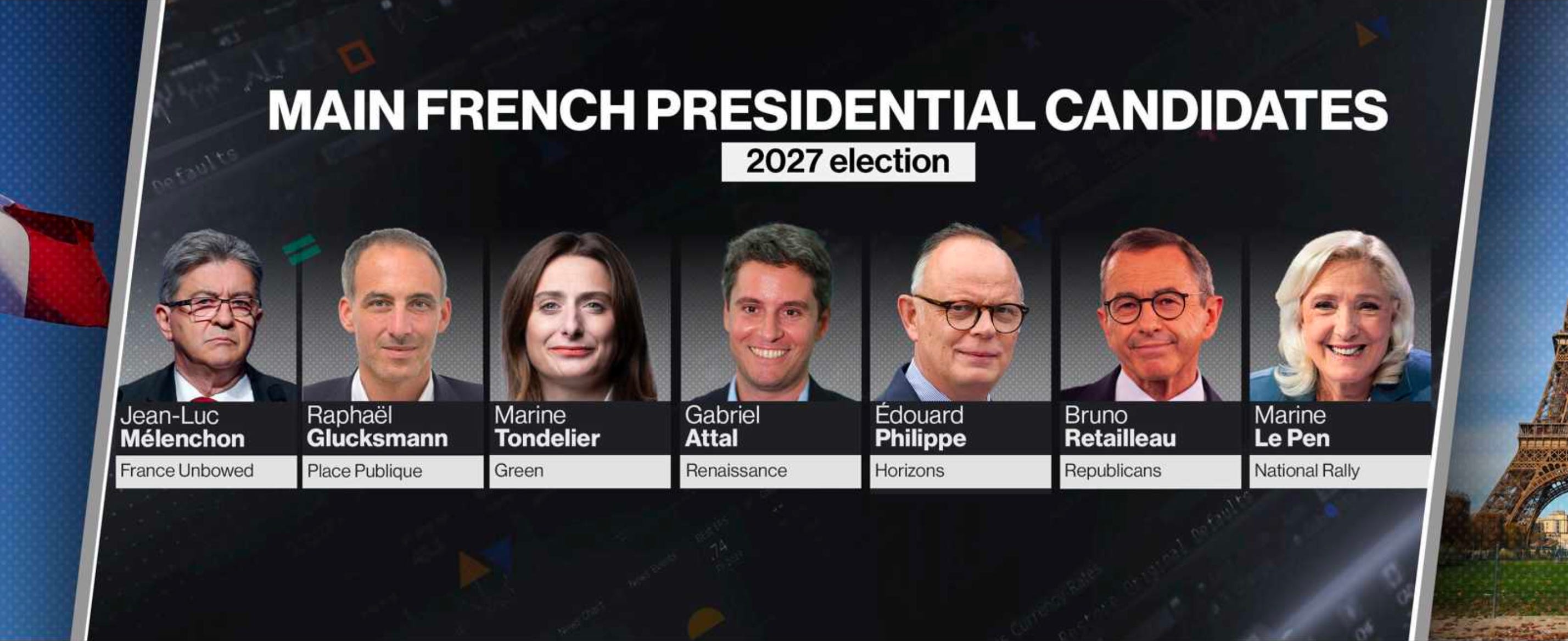
Mélenchon doubled down on his plan to cancel debt held at the European Central Bank as a negotiable package with other euro members, telling Reuters he would be willing to go further and “just take the bonds and burn them.” We have heard similar appeals before: in Europe as the euro zone debt crisis detonated, and around the same time in the US. Debt cancellation, however, is nothing more than monetary financing and would be highly inflationary.
As these ideas increase, the case for investing in real over financial assets only strengthens. Mélenchon may have said it, but this is in no way a realistic outcome. Yet, even if low-probability, high-impact events don’t come to fruition, they materially warp the distribution of risks, skewing it with fatter tails. We should take them seriously, particularly now that the US Treasury has panicked over its long-end buyback announcement.
We expect to hear more avant-garde debt approaches, such as cancellation, in the months ahead and not just in France.
Former prime minister Philippe said the debt effect “risks generating an extremely brutal shock that will hit hardest those most exposed.” He dismissed Mélenchon’s proposal as “extremely dangerous” and risking cutting France off from financing.
Le Pen, meanwhile, claimed her savings plan of €125bn ($146bn) could be achieved by shrinking the French state, cutting immigration, and possibly reducing contributions to the EU. She proposed a constitutional “golden rule” to ensure balanced budgets, saying she would make sure France honoured its debts.
She reiterated her pension reform, allowing retirees to cash in on their schemes as soon as age 60, which she puts at around €9bn a year.
What options does France have to reduce its debt? Fiscal consolidation is too risky to drum up the votes for, and growth is already heavily driven by massive deficits (and forced down by austerity in the past). Inflation is already an issue for rising interest payments. Financial repression is coming, but too late to save the day (it’s already partly at work via enhanced Treasury buybacks). Selling off government assets such as the gold that sits in Fort Knox may make a one-off splash, but it’s unlikely to move the dial. Debt restructuring or default would cause more damage than good.
Macron seems stuck in a bind: no parliamentary majority, no budget room, and no political capital. It is not obvious what Emmanuel Macron can do to stop the bleed. Instead, the risk is that the bleed accelerates.
The 15y15y forward rate is a way of looking at borrowing costs that strips out the impact of near-term monetary policy. The spread between this metric for France and the equivalent German rate is now just short of its highest level since 2012, a sign that investors are pricing a structural deterioration in France’s financial health relative to Germany in the coming decades.
So what is the story for investors? France’s fiscal arithmetic may be ugly in aggregate, but markets will not experience the adjustment in aggregate. Any credible attempt to stabilise the debt trajectory will create winners and losers across sectors, households, and asset classes depending on where the government chooses to find the money. Tax rises, spending cuts, pension reform, changes to corporate incentives, and further pressure on household savings would each transmit through the French equity market in very different ways.
The approach, therefore, is to determine how it tries to consolidate, who ultimately pays, and where that pain is likely to appear first in markets. We start here, then turn back to the sovereign complex and lay out our convictions on OAT yields and the relative-value trades we prefer across European government bonds.
Below the paywall, we detail our favoured stock-specific long/short trade, which we believe has asymmetric opportunities, along with three rates trades, including one relative play that we have added to our portfolio.
Equity Approach
Constituents of the country’s benchmark CAC 40 Index make less than 20% of revenues at home, which limits the impact of political risk on earnings. However, domestically focused sectors such as banks, utilities, telecoms and construction do feel the stress of a wider French-German yield spread. A bigger yield gap reduces the attractiveness of French stocks and keeps a lid on companies’ ability to invest, ultimately hurting their competitiveness.