

To what extent is the US dollar becoming an AI trade?
Market dynamics have been paradoxical in this regard. As the AI investment boom has obsessed markets in recent years, it has played an instrumental role in sustaining US economic exceptionalism and attracting foreign capital into US assets. Yet in recent weeks, as the AI equity trade has come under pressure, the dollar has also benefited.
Understanding this relationship requires separating the financial market implications from the underlying economic activity that AI generates. Three principal channels through which AI is influencing the greenback are global risk appetite, relative economic growth, and monetary policy.
All three offer varying degrees of support for the greenback. The durability of that support will depend on how the AI investment cycle evolves.
King of the Castle
The first channel through which AI is influencing the dollar is global risk appetite. As November price action has clearly demonstrated, a disorderly selloff in AI equities can support the greenback, even as US assets are at the epicentre of the shock.
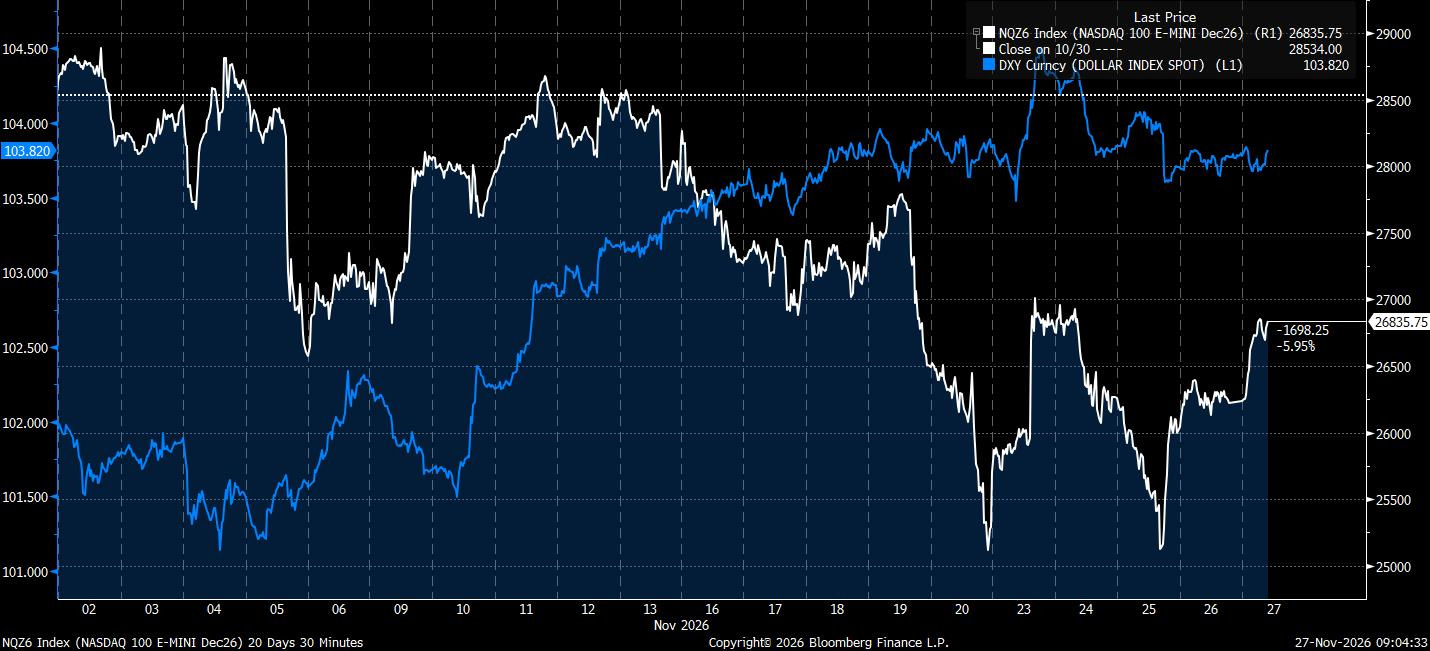
We would argue that the geographical distribution of risk is more important for FX than the geographical origin of the shock. With the concentration of global equity benchmarks and international portfolios being in a handful of technology names, a significant repricing of the AI trade has implications for risk exposure that extend well beyond US borders.
A sustained correction, alongside rising cross-asset volatility, would force systematic deleveraging across portfolios. Given the dollar’s central role in funding markets, the need to meet margin requirements, and to repay incremental dollar-denominated liabilities can generate incremental demand for the greenback, while rising volatility also reduces the attractiveness of FX carry trades, placing further pressure on currencies sensitive to global risk appetite.
There are, of course, competing flows here. Foreign investors liquidating US equity holdings and repatriating the proceeds could generate USD selling pressure, particularly where existing currency exposure is unhedged. However, in a disorderly correction, we would expect the broader reduction in global risk exposure and associated demand for dollar liquidity to outweigh these flows. The dollar’s performance, therefore, would likely be most pronounced against higher-beta G10 and EM currencies, with the Aussie and Scandies among the more vulnerable expressions.
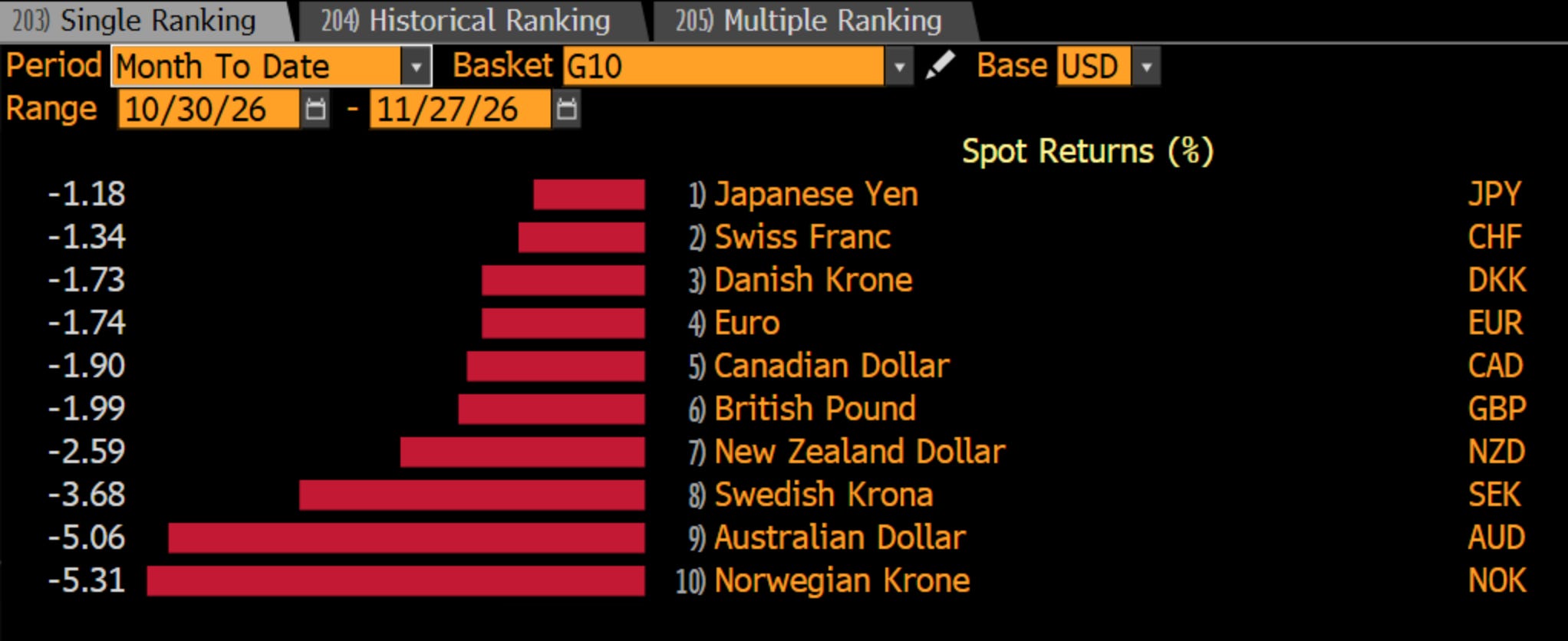
While a dovish repricing of the Fed could partially offset these dynamics, we expect liquidity considerations to dominate rate differentials in the initial stages of any disorderly correction.
Beyond this defensive bid, however, the more interesting question is whether a deterioration in the AI equity trade is sufficient to undermine the fundamental economic arguments for holding the dollar.
Exceptionalism Beyond Equities
We would draw a clear distinction between an AI equity market selloff and an actual slowdown in AI-related economic activity. The former does not necessarily precipitate the latter.
Nvidia offers a good illustration of how financial market expectations can deteriorate without a corresponding deterioration in underlying demand. The quarter was a broad beat-and-raise, with revenue more than doubling year over year and guidance raised above consensus on virtually every metric. Yet the stock was still caught up in the broader market selloff (and some internal affairs, apologies for the pun). Whilst Nvidia had other catalysts that amplified the move, the broader semiconductor complex is undergoing a significant repricing, with the Philadelphia Semiconductor Index down 40% since early October. Yet the demand backdrop for these companies has not deteriorated nearly as much. Semiconductors remain the principal beneficiaries of hyperscaler capex.
The Bureau of Economic Analysis data suggest AI-related investment added approximately 1% to US GDP growth over the past year, accounting for around half of the overall economic expansion. Torsten Slok, Chief Economist at Apollo, says AI investment added roughly 1.3% to real GDP growth over the last three quarters, or about 65% of the roughly 2% cumulative growth.
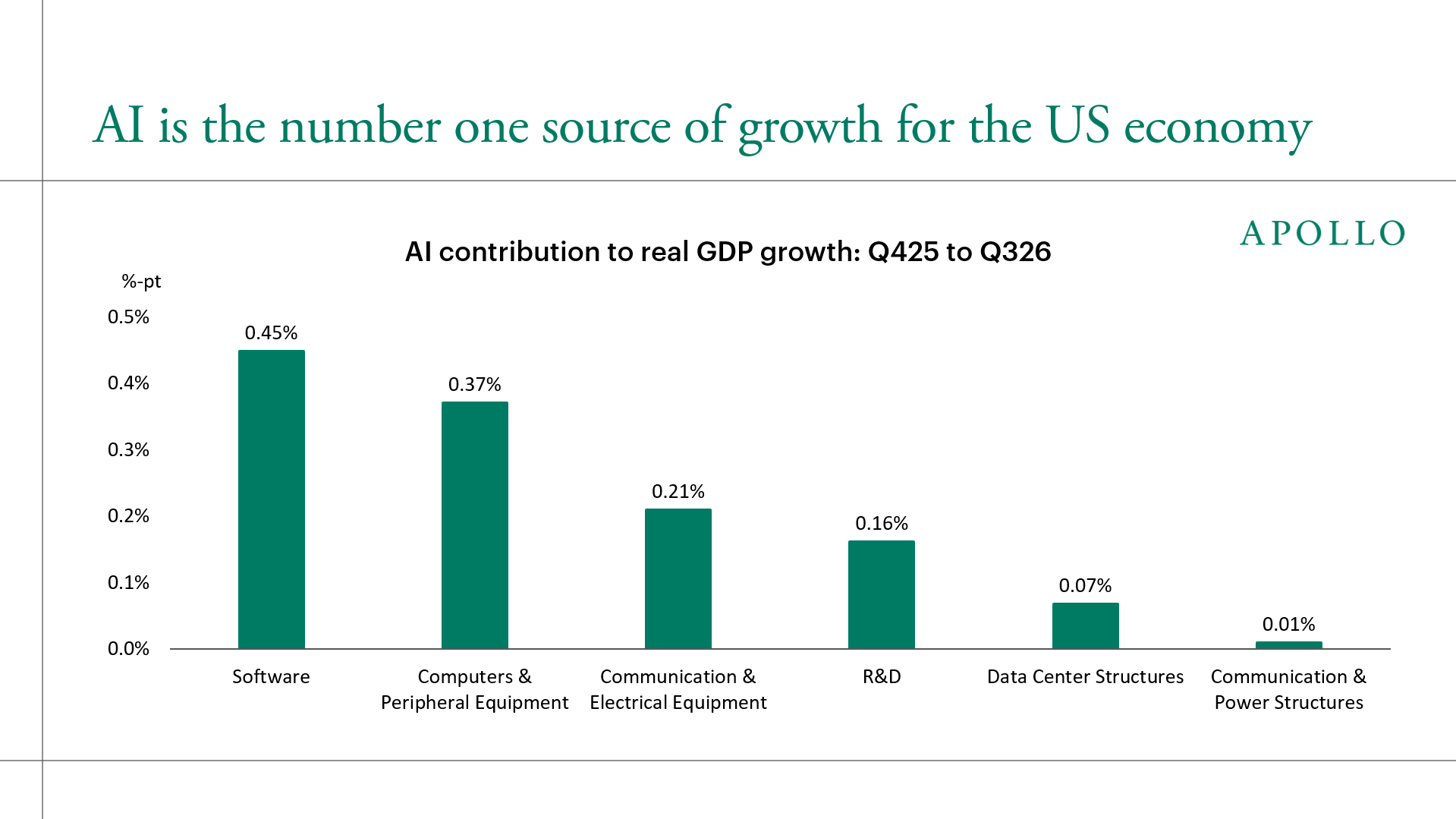
The investment cycle has a certain level of resilience behind it that will lead it to extend beyond the equity cycle. Much of the AI-tagged expenditure is driven by multi-year investment commitments and contractual obligations, rather than near-term equity market performance.
Beyond its contribution to GDP, the AI narrative has attracted substantial international capital into US assets. To the extent that these investments remain currency-unhedged, continued foreign allocations represent an additional source of demand for the dollar. Even if technology stocks struggle to deliver positive returns, a sustained investment cycle can preserve US growth differentials and, with them, the relative attractiveness of US assets.
There is also a potential structural feedback loop here, whereby the dollar revenues accumulated by semiconductor-exporting economies are recycled back into US financial markets. This concept of “chipdollar” recycling, a modern-day parallel to petrodollar flows, is something we will explore in greater depth in a separate note.
For FX markets, the composition of that growth is arguably as important as its magnitude. The economic activity generated by building AI infrastructure has very different implications for inflation and monetary policy than the eventual productivity gains the technology promises.
Inflation Before Disinflation
The sequencing of AI-related expenditure and productivity gains affects rates and FX. In the short run, although it boosts growth, the tsunami of spending on AI development is likely inflationary rather than deflationary, as extra demand hits the economy ahead of the productivity payoff. That being said, in the long run, AI is likely to be a significantly disinflationary force.
The inflationary consequences of the AI buildout are perhaps more apparent further upstream in the economy. The scale of investment is placing incremental pressure on electricity generation, construction capacity, skilled labour and industrial inputs.
After more than a decade of no growth, US electricity production rose by 2.5% in 2024 and 2.4% in 2025, with this trend continuing in 2026. Yet electricity has just a 2.5% weight in the CPI basket, so any feed-through is minimal (about 0.1% of the headline figure). Similar pressures are evident in memory chips, where prices have soared amid the AI buildout, raising input costs for manufacturers of laptops, smartphones and even autos. Whilst only a portion of these additional costs is likely to be passed on to consumers, the inflationary impulse is more pronounced at the producer level.
On balance, AI remains far from the most important driver of consumer inflation. However, looking solely at the CPI basket risks understating the broader inflationary consequences of the investment cycle. Competition for capital, labour, and industrial inputs is intensifying as the Fed grapples with persistent inflation.
Strong aggregate demand before the associated supply-side benefits materialise limits the scope for monetary easing and may necessitate further tightening (although there is an argument that continuing to tighten amid current cross-asset weakness may lead to a “something will break” outcome).
As for yields, inflationary knock-ons from the AI-investment cycle have put upward pressure on the short end, and may continue to do so independently of what the Fed does. At the long end, AI debt issuance has pressured yields higher via “crowding out” effects. Sovereign bond yields are unlikely to fall much until the AI-related debt binge fades.
The longer-term counterweight is productivity. Higher output per worker, lower unit labour costs and improved corporate efficiency could allow the US economy to sustain stronger growth without generating additional inflation. This is a trend we’re already starting to observe.
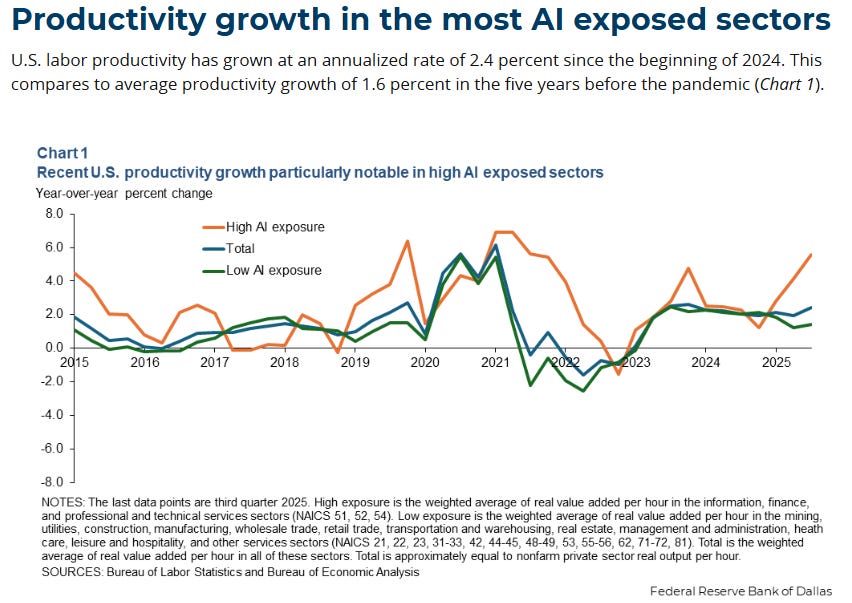
Productivity gains are not unambiguously dollar-negative, though. If the US captures a disproportionate share of those gains, productivity could reinforce US economic exceptionalism and attract further foreign capital. The dollar-negative argument therefore relies more specifically on the implications for relative monetary policy.
Our dollar outlook ultimately depends on where we are in that economic transition. Over the short and medium term, we expect the demand-side consequences of AI investment to outweigh its realised supply-side benefits, tilting the balance of risks toward a relatively hawkish Fed and a supported dollar.
When AI Stops Supporting the Dollar
Risks to this outlook could materialise due to financial market developments or economic deterioration.
Our base case, in the event of further equity pressure, is that investors would reallocate capital within the US rather than materially reduce their exposure to US assets, whether through rotation into bonds or equity sectors with less demanding valuations. Whilst bond inflows could narrow yield differentials, domestic portfolio reallocation would not generate the same direct USD selling pressure as geographical diversification.
But should investors become less convinced by the prospect of sustained US technology outperformance, the relative attractiveness of UK and European markets could increase, and this reallocation of international portfolios away from US assets could generate structural USD selling pressure, particularly where existing currency exposure is unhedged, offsetting demand for dollar liquidity associated with a disorderly correction.
On the economic side, we believe the AI investment cycle has sufficient resilience to withstand a prolonged period of equity market weakness, as multi-year commitments provide short-term insulation, but it is worth considering the risk of an AI investment downturn. Although one does not trigger the other, the two are not entirely independent. A prolonged deterioration in equity valuations can eventually influence corporate investment decisions, especially as lower valuations diminish the benefit of equity financing channels and debt financing channels have already been used extensively.
Shareholder pressure would also be a factor here, as was evident in the recent Nvidia board actions and subsequent about-face decision. We wouldn’t rule out similar pressure on hyperscalers if share underperformance were widespread. Incremental commitments, project expansions, and subsequent phases of the buildout would remain vulnerable in this case.
Given AI’s outsized contribution to US GDP growth, even a moderation in the growth rate of expenditure, rather than an outright contraction, could materially weaken the US growth impulse. A weaker investment cycle would simultaneously undermine US growth exceptionalism and reduce some of the inflationary pressures associated with the buildout.
This is where the sequencing of such a downturn comes into play. We would expect the deterioration to manifest first in equity markets, where a prolonged period of poor returns may eventually force a reassessment of investment commitments. In the interim, the dollar could continue to benefit from defensive flows in periods of market stress, whilst the underlying economic and monetary policy arguments for holding the greenback remain largely intact.
The inflexion point would likely come when markets move beyond questioning the returns on AI investment and begin questioning the continuation of that investment itself. A repricing of future expenditure would bring the US growth differential and the Fed’s policy trajectory into question, potentially outweighing the defensive bid for the dollar. Importantly, FX markets would likely discount this economic deterioration well before it became apparent in the hard data.