

All the focus is on yields.
Implied yields on G7 government debt with maturities beyond 10 years had climbed above 4.6% for the first time since 2004. The US 30-year Treasury is around 5.17%, the UK 30-year gilt touched 5.82%, and the Bank of Japan is being forced to consider whether market instability might require a slower pace of balance-sheet run-off.
Each country may have individual reasons adding to its bond selloff, but the selloff itself is global.
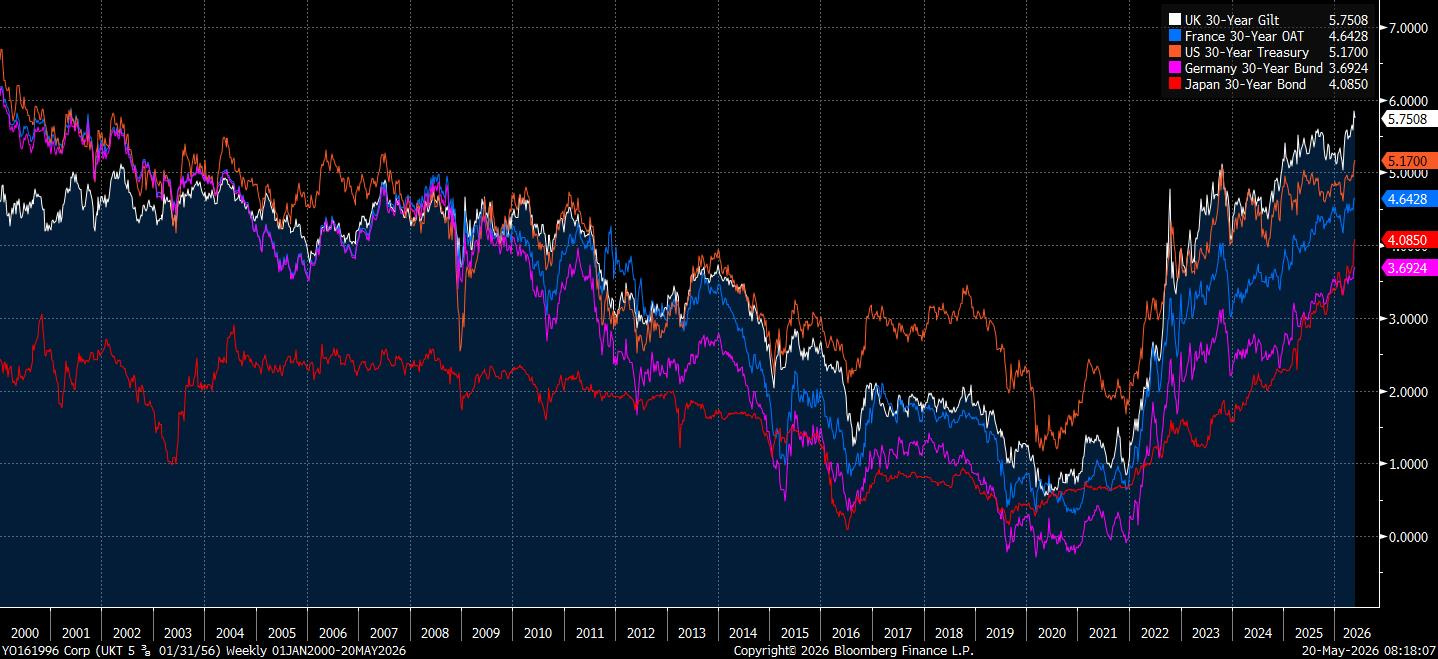
There is one main story driving this higher, a noisy one of war, oil, and inflation expectations. Markets now have the Fed on hold through 2026, and have shifted far enough to price a possible hike by January. Beneath that headline story, there are a few dynamics we think deserve more attention.
The first is that hyperscalers are funding an AI buildout of extraordinary scale, and have increasingly leaned on debt markets to do it.
The second is that a continued shift higher in rates changes the equity leadership map, making financials and banks a more natural home for risk than the most duration-sensitive parts of the market.
The third is that the UK has its own idiosyncratic fiscal and political vulnerabilities, which give long-end gilts a higher beta to the global duration selloff than US Treasuries or most other G10 markets.
Not all rising yields are equal. A move driven by collapsing credit quality is one thing. A move driven by stronger nominal growth, higher real rates, and a fatter term premium is another.