

SUMMARY:
- Takeaways from last week in cross-asset markets
- Thoughts and key considerations ahead of the upcoming week
- House views and expressions
US equities finished modestly lower, but the headline move understated another difficult week beneath the surface, particularly for the parts of the market most exposed to the AI investment cycle.
The S&P 500 fell 0.6%, the Nasdaq 100 1.6% as assessments of hyperscaler spending and technology valuations continued ahead of a crucial run of mega-cap earnings. Alphabet provided the first test, and the market didn’t like what it saw. Revenue beat, but management raised its 2026 capex forecast to as much as $205 billion, reigniting the debate over how much capital the AI buildout can absorb before investors begin demanding more evidence of returns.
Alphabet, Amazon, Meta, and Microsoft had already indicated combined spending of around $725 billion this year, and Alphabet’s updated guidance suggests that figure could move higher as the remaining hyperscalers report. More so, Alphabet generated negative quarterly free cash flow for the first time since becoming a public company. The tolerance for spending without an obvious near-term payoff is narrowing.
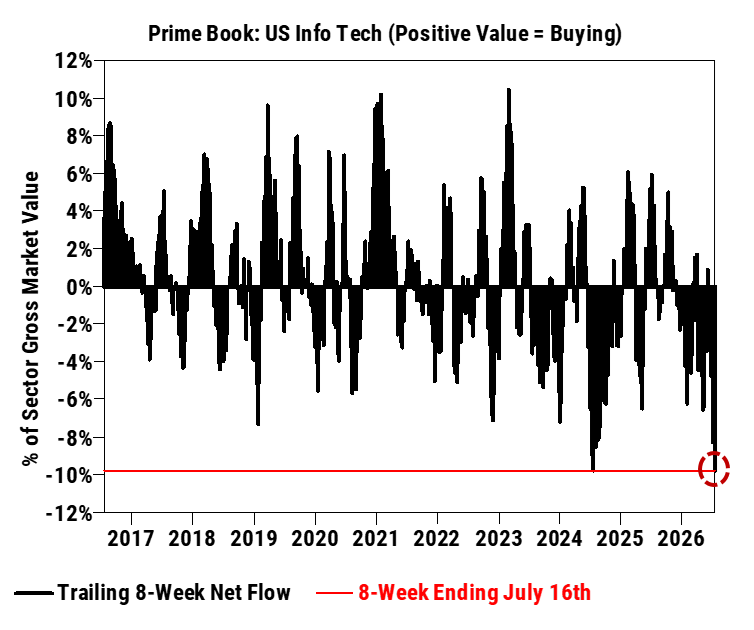
Goldman Sachs’ PB data showed hedge funds have net sold US tech at a record pace over the past eight weeks. The SOX index is now on course for its worst month since June 2022, and Mag7 lost almost $800 billion of market value on Thursday alone. Markets are also targeting large VIX call spreads in the 45-65 area for August and September. Pay up for protection heading into the thinner summer liquidity period.
The macro backdrop did little to provide relief. There were no major US releases and the Fed remained in blackout, leaving markets to continue repricing the policy path ahead of Wednesday’s FOMC meeting, in a new environment where Warsh’s reaction function to data is still unknown. OIS prices a full 25bp hike by September, with further tightening priced in early 2027.
The repricing supported another strong week for the dollar. Renewed haven demand from Iran and higher short-end US yields took the dollar close to its year-to-date high. USD/JPY drifted to near 164. Higher-beta currencies have begun to show larger moves as US rate volatility increasingly feeds into FX markets, particularly since the Fed stepped away from traditional forward guidance.
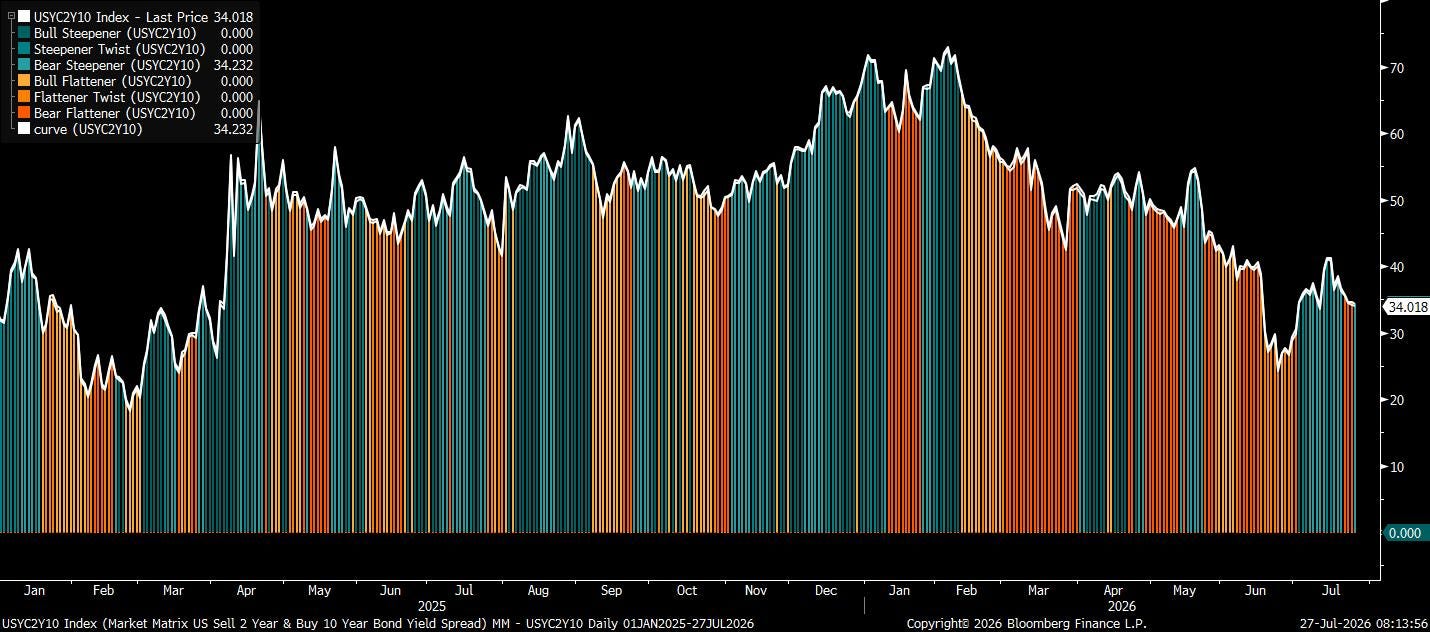
Treasuries reflected a similar dynamic, with the curve flattening sharply from the five-year sector onward. Put demand increased as investors hedged against further yield upside, although open-interest data suggests much of the move has still been driven by existing longs being liquidated rather than a large build-up of outright shorts. The FOMC is on Wednesday, and markets are taking the hawkish side.
This week, therefore, has the potential to determine whether the recent tech weakness remains a rotation or becomes broader. Microsoft and Meta report Wednesday, followed by Amazon and Apple on Thursday. After Alphabet, the market will look beyond headline earnings beats and focus on capex and margins as evidence that AI investment is generating acceptable returns.
The bar is high.
Let’s get into the guide to trades moving markets, where things stand, and where they may be heading.
“Oil Is Again the Macro Variable”
“Policy Can Do Only So Much (JPY)”
“Summary of House Views”