

A busy calendar of central bank action is on the cards next week, giving markets the comforting illusion that currency markets will be easier to explain. A hike or a hold, a presser, some repricing at the front end of the curve, and currencies follow. If only it were that simple.
The RBNZ, BoC, Fed, ECB, and BoJ land between Tuesday and Friday, with the BoE the following week. Who hikes, holds, or cuts is one thing (who are we kidding, no one is cutting), but wheter these decisions alter the narratives currently priced is where the focus is.
American exceptionalism has become synonymous with the AI trade, and stronger investment, resilient growth, and inflationary consequences of a capex boom have supported US rate differentials and, by extension, the greenback. Yet what provides a tailwind on the way up can become a headwind on the way down. Europe faces a different predicament, as not all yields are created equal. Investor demand for compensation due to Europe’s fiscal and credit risk has driven EGB yields higher, but that pressure has hindered the Euro rather than creating the usual rate advantage. Elsewhere, the UK faces a familiar test of fiscal credibility. The Autumn Budget looks set to favour restraint over ambition, but with much of the good news already priced into sterling, avoiding another gilt market scare may prove easier than delivering further upside for the pound.
G10 monetary policy is still broadly synchronised. Identifying where the prevailing economic narratives begin to diverge is where the opportunities lie. And plenty of potential for divergence remains.
Being right about the central bank and wrong about the currency can be an occupational hazard in FX. With that in mind, we look at the major currencies heading into the next fortnight, where the balance of risks may be shifting, and where we see opportunities of value.
For the rest of this note, we’ll look at how each central bank plays into the currency’s narrative, and summarise our convictions into three trades to see the year out.
USD: When Exceptionalism Becomes a Liability
US economic strength and resilient equity performance have been strong AI-driven tailwinds for the greenback for much of this year. Those same factors also present a potential source of weakness.
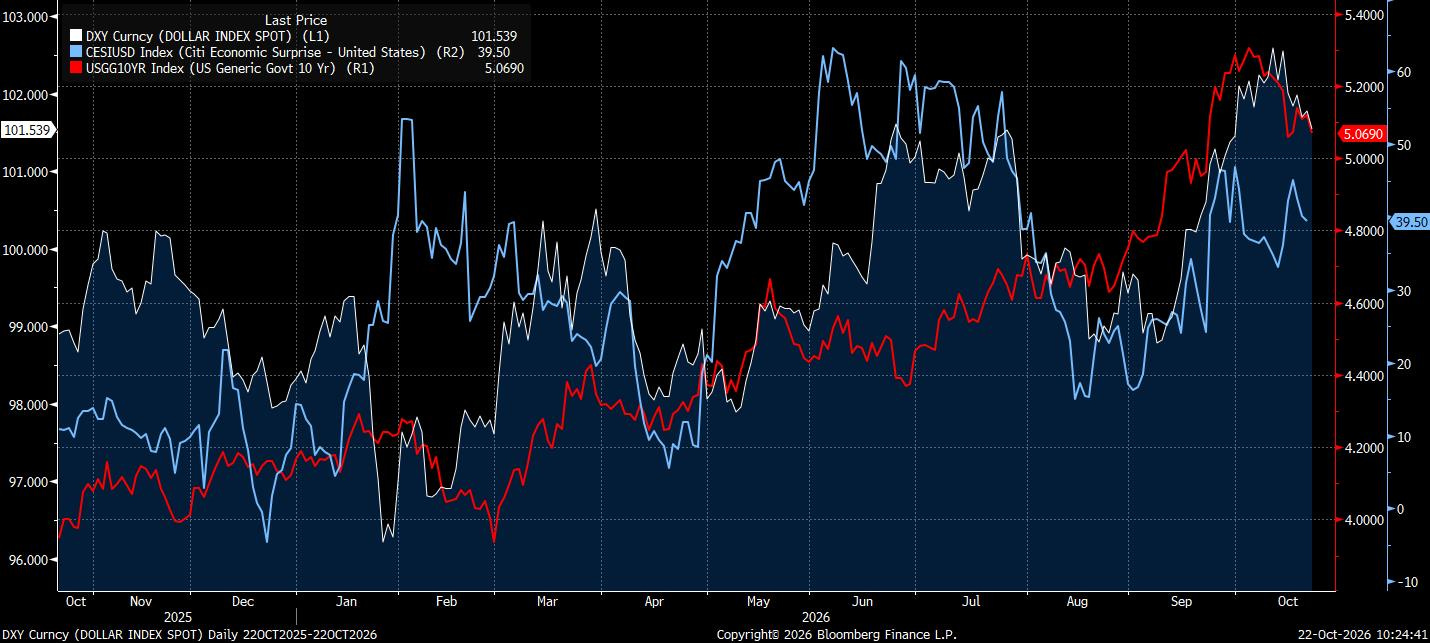
The AI investment boom has generated extraordinary spending, with consequences beyond stock market returns. In particular, capex spending has added to near-term inflationary pressures while also supporting economic strength. With the US disproportionately exposed to both, interest rate differentials have shifted in the dollar’s favour. This, however, works in both directions.
The dollar’s underperformance last week amid renewed AI concerns and a sharp tech sell-off closely resembles the DeepSeek sell-off in early 2025, which was also a clear negative dollar event in real time, the flipside of the US’s outsized exposure to this theme. However, dollar underperformance was more pronounced this time around despite less equity underperformance. Part of this may have stemmed from outside the US, where European markets found some relief on the back of a global duration rally and eased credit concerns.
The FOMC meeting next week is a key event, but we see little chance that the Fed’s outlook will change much. We expect a hold in October and a hike in December. It will be in that December meeting that we could get more info on the path for 2027, along with a few more inflation prints in hand for assessment.
Therefore, the key dollar driver will remain these outside factors. A significant reduction in expected AI-related demand would weigh on the greenback, given its exposure and the lofty valuations tied to this spending. On the other hand, sustained capex spending could bring renewed upside pressure, something Warsh has highlighted himself.
AI spending concerns remain an ever-present risk in many markets, but for now, we still don’t put much weight on spending slowing down. So dollar risks remain skewed to the upside.