Although US equities managed to finish in positive territory for the week, no one would conclude that it was a quiet week of trend buying. Under the surface, the tape had to digest a violent midweek drawdown, the largest IPO in market history, a European Central Bank (ECB) rate hike, fresh inflation ambiguity, another round of Iran-related geopolitical stress, and a very public reminder that the AI trade is no longer moving as a single clean block.
The S&P 500 ultimately recovered from Tuesday’s 2.3% intraday drawdown, with the Nasdaq 100 helped by Friday’s successful SpaceX debut. In a market increasingly starved of clean positive catalysts, the IPO gave investors one. SpaceX priced its $75bn offering at $135 per share, opened at $150 and closed at $160.95, giving the company a fully diluted valuation of roughly $2.2tn. That made it more than just another listing. It became a test of whether public markets still had the balance sheet, appetite and imagination to absorb a mega-cap growth story at a premium valuation.
For now, the answer was yes. Demand was reportedly multiple times oversubscribed, with several institutional orders of $10bn or more and visible participation from Gulf sovereign wealth funds. This mattered because it framed the listing as something bigger than a retail liquidity event. SpaceX has become a global capital allocation story, sitting at the intersection of space infrastructure, defence optionality, AI compute geography, sovereign ambition, and Elon Musk’s retail gravity machine. The first-day performance lifted risk sentiment into the close, but the real test starts now. If SpaceX continues to trade well, it can remain a risk-on barometer. If the stock starts to fade, the speculative bid that carried markets into Friday could disappear very quickly.
The macro backdrop is less forgiving. Last week’s ECB hike was the clearest signal yet that central banks are not ready to look through the Iran shock. The ECB raised the deposit rate by 25bps to 2.25%, its first hike since 2023, and framed the decision around the broader inflationary impact of the war rather than energy alone. We’ve now shifted our view from thinking the ECB would halt at one insurance hike to now looking for multiple further hikes this year, something we explained last week in “After You, Christine”.
Let’s get into the guide to trades moving markets, where things stand and where they may be heading.
“Same Old Global Playbook”
“Warsh in the Hot Seat”
“UK Risk Premium Gets Two Votes”
Same Old Global Playbook
Markets keep deciding, after briefly noticing the risk, that it is still better to buy the same winners.
Wars, oil shocks, higher yields, and occasional policy scares are all still capable of producing a wobble. But they are not yet capable of producing a durable change in equity leadership. The market continues to come back to the same trade: AI-linked momentum, semiconductor earnings, hyperscaler capex, and the equity markets most exposed to that supply chain.
If that sounds too simple, remember that simple has been working… a lot.
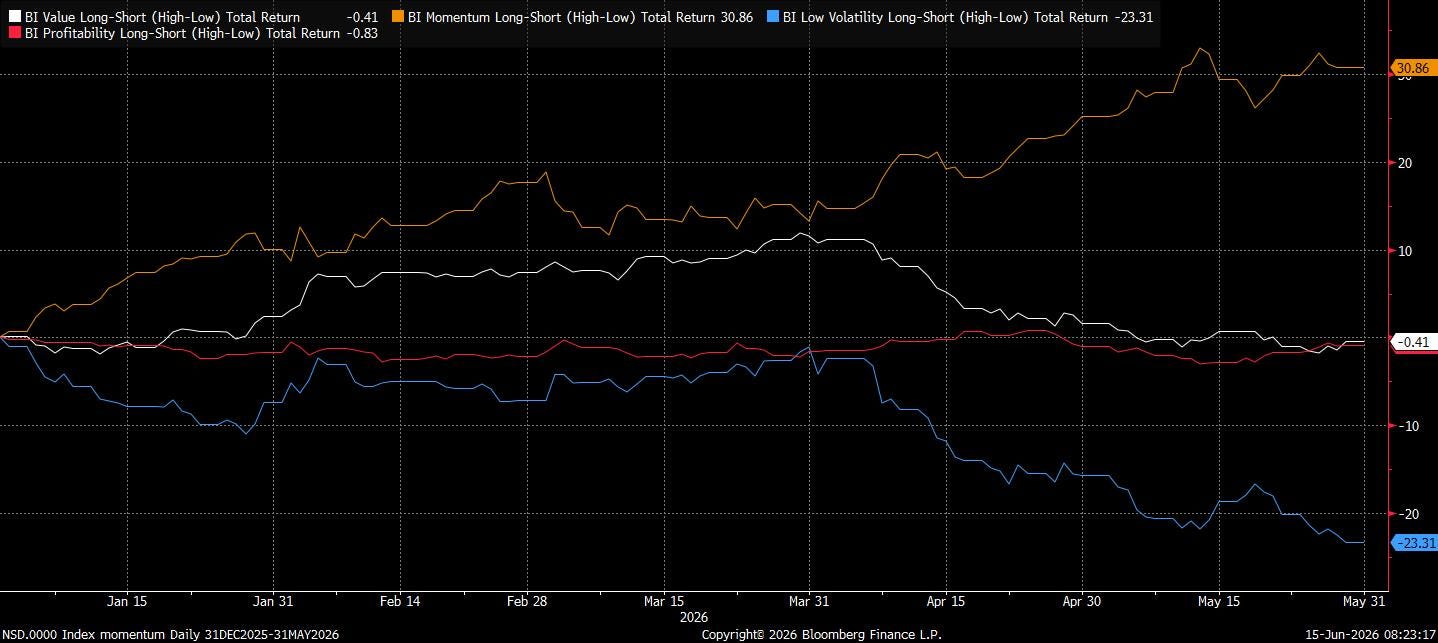
Momentum remains the dominant factor globally, up nearly 31% year-to-date. Low-volatility stocks, by contrast, are down 23% and remain the worst-performing global factor. Value has made occasional appearances, but has not managed to take control outside a few regional pockets. The market keeps flirting with rotation, only to return to concentration.