

“Anthropic IPO.”
Those words have appeared in many headlines recently, not only because the company filed its S-1 on October 26, but also because it presents itself as the world’s fastest-growing software company, and its IPO roadshow is now well underway. The upcoming IPO next Thursday (November 19) also tests the economics of frontier AI in the public markets.
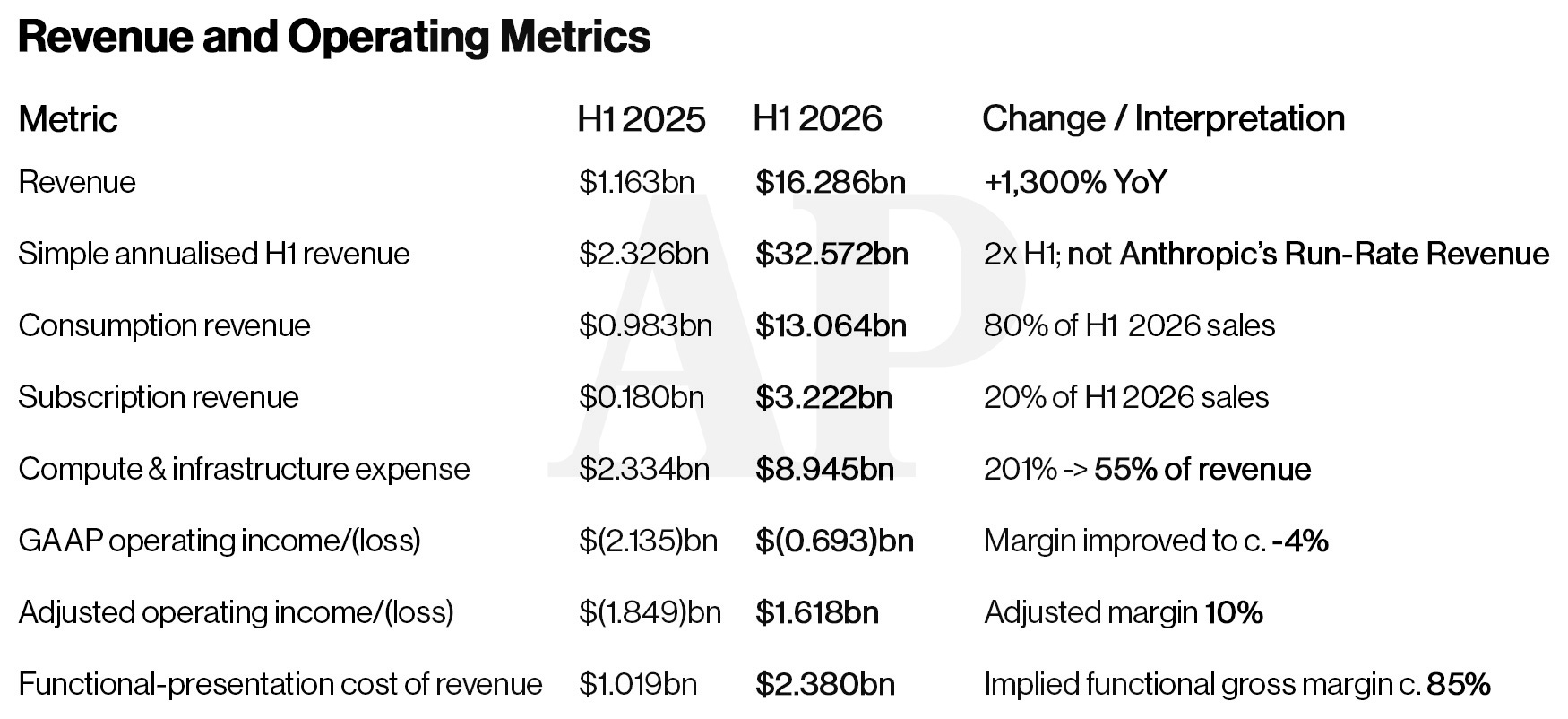
The S-1 showed revenue increased from $1.2bn in the first half of 2025 to $16.3bn in H1 of this year… of which $11.6bn came in just the second quarter. The GAAP operating loss narrowed to (just) $693mn, and operating income turned positive at $1.6bn. Yet the same filing, while showing impressive revenue and growth that dent the AI bear case, also revealed an infrastructure strategy that has committed Anthropic to potentially hundreds of billions of dollars in future compute expenditure.
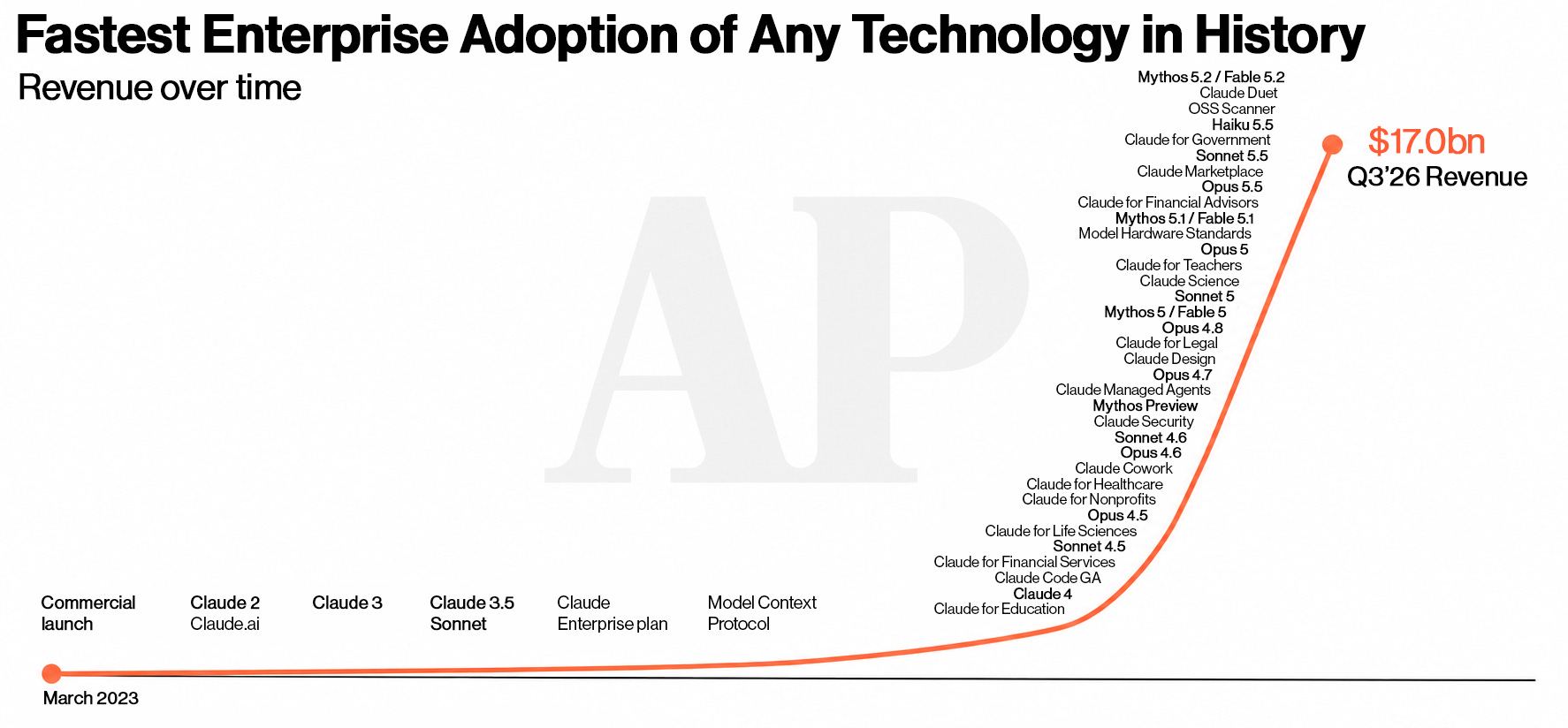
This is the central tension in any investment case for the Anthropic IPO: monetise intelligence on a short-duration, largely consumption-based basis, while securing compute capacity to produce that intelligence years in advance.
However, the architecture behind the compute demand shifts risks away from Anthropic, as it has built a capital-light financing model relative to the self-build cost of the same infrastructure. Amazon, Google, and Microsoft provide cloud capacity. SpaceXAI, NScale, and Lambda supply large blocks of GPU compute. Broadcom leases TPU-based infrastructure, and AMD provides another route to accelerator capacity. Hyperscalers and neoclouds ultimately finance or operate a substantial portion of the physical build, limiting Anthropic’s need to construct the data centres, but this means capacity delivered to Anthropic becomes a service or lease expense.
Capital light, but not necessarily economically light.
Turning to the valuation question, an extraordinary historic growth rate has propelled Anthropic to the forefront of AI, but recent bumps in the AI road mean a slight rerating in the Anthropic IPO, with the valuation falling by about $600bn. 825 million shares are being floated in the $70-$78 price range, with the midpoint signalling a $1.33tn market cap (roughly 41 times annualised H1 revenue) and raising more than $68bn at the offering.
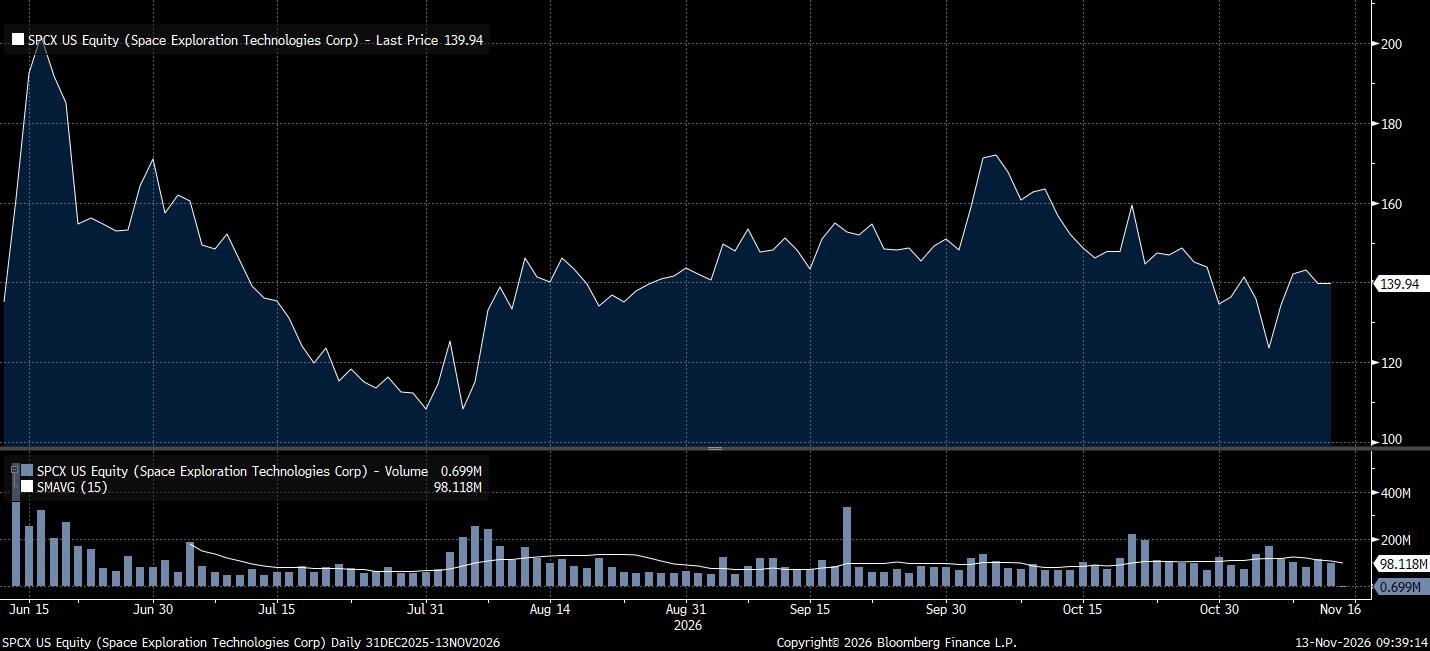
The IPO’s market structure could initially overwhelm fundamental concerns about the company and its price. The SpaceX precedent shows how scarcity can amplify early door price swings, as pre-IPO demand through ETFs, along with leveraged and inverse single-stock ETFs, plays a role. SpaceX rose 20% in each of its first two sessions before eventually trading below the offer price, with about $85bn of stock changing hands on day one. Anthropic’s lock-ups and constrained float will likely reinforce a similar dynamic in the short term, though the specifics have not yet been released.
Another important mid-term consequence of the Anthropic IPO is equity issuance. Companies either create shares or retire them, asking investors to absorb more equity or removing equity from circulation. The latter has been a pillar of support for equity indices for much of the past two decades. But three, fair to say, “behemoth” IPOs will land in fairly short succession. SpaceX is done and dusted, Anthropic next, and OpenAI will be here in due time. A fair bit of issuance. More and more, we’re seeing hyperscalers shift to equity issuance rather than raising more debt as financing costs rise and CDS shows increasing signs of concern. Meta was the most recent headline to raise cash through equity issuance, up to $95bn.
That leaves us with a broader question for the rest of this memo: Can Anthropic turn extraordinary demand into sustainable profits without being overwhelmed by its infrastructure commitments, and, if the dot-com era is any guide, is the best investment really the frontier itself, or the ecosystem being built around it?
Getting a Price for Intelligence
Anthropic’s IPO will be the first public offering for direct access to frontier AI, something that has been missing from the four-year AI boom since ChatGPT’s release. SpaceX offered partial access by merging with xAI and launching its IPO in June; Alphabet has Gemini, along with a behemoth, yet slowing, search engine business; but Anthropic offers a direct, pure-play frontier AI offering and, to us, a far more symbolic part of the broader AI story.
So, markets get a pure price for intelligence. Whether investors decide that price is right will depend on varying assessments. Under consideration will be whether frontier AI can develop durable software-like economics despite the cost of producing inference and training capacity, dynamics that investment markets have spent the last two decades rewarding handsomely. Alongside this is the question of infrastructure financing, and whether it preserves free cash flow. And in that final price for the frontier will be scarcity dynamics and investor demand to sustain a valuation that expects years of further hypergrowth.
The S-1 filing does give us a small argument that both bulls and bears will flip toward their bias: revenue growth. This is hardly a new dynamic for a growth stock, but Anthropic’s revenue has moved from $41mn in 2023 to $386mn in 2024, $4.6bn in 2025, and $32.6bn (annualised on H1 figures) for 2026. A near 800-fold increase in three years is impressive, but it won’t continue in the years ahead, even under the most optimistic figures. Anthropic itself has stated that the early-adoption dynamics may not be sustainable. Customer usage has been sensitive to model releases and seasonality.
“Pay-for-Intelligence”
A quick look into the business dynamics of Anthropic.
Anthropic describes its principal commercial model as “pay-for-intelligence.” Most revenue comes from token usage across its product family, which includes Mythos, Fable, Opus, Sonnet, and Haiku. Subscriptions are part of the business, but the revenue split shows it is consumption-led. Tokens account for about 80% of H1 2026 revenue, with subscriptions making up the remaining 20%, but they typically run for 12 months or less — $13.1bn and $3.2bn, respectively.
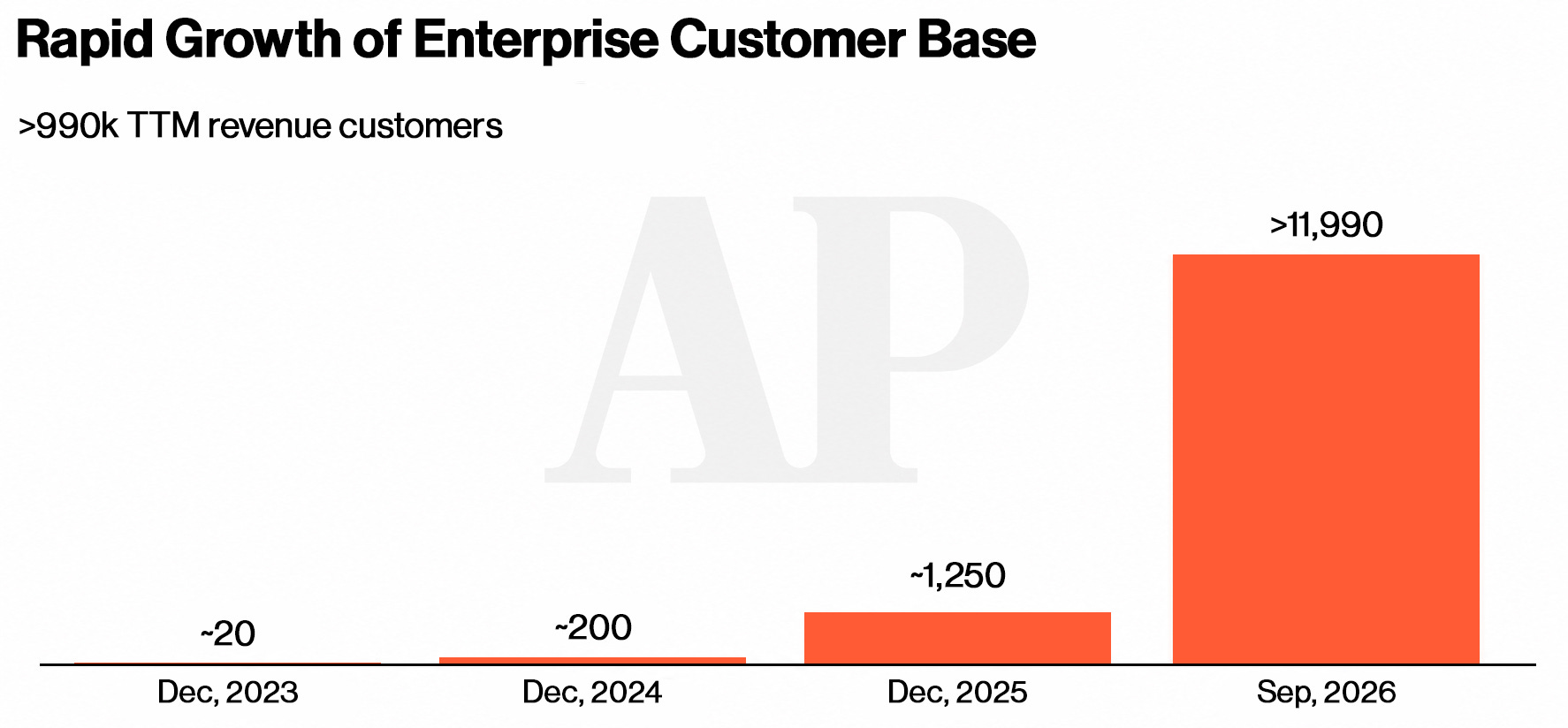
This is where Anthropic differs from a SaaS model. In conventional SaaS models, revenue growth is led by customer growth, selling more seats and raising subscription costs. Anthropic’s revenue trajectory provides perhaps the clearest evidence yet that enterprise AI adoption is extending well beyond experimentation. With four-fifths of revenue generated through consumption, not subscriptions, spending is increasingly tied to how extensively companies deploy AI across their operations. Customers producing at least $100,000 of TTM revenue rose from around 20 at the end of 2023 to roughly 200 in 2024, 1,250 in 2025 and more than 11,900 by September 2026. More than 1,900 customers were at $1mn-plus and roughly 250 at $10mn-plus. No individual customer represented more than 10% of revenue during the first nine months of 2026.
Compute Commitments
This is where Anthropic becomes more than a high-growth story. As of the end of H1, the company has about $265.6bn in future fixed or minimum guaranteed commitments, with terms ranging from one to 20 years. There is also $321.4bn of signed leases that have not yet commenced. A simple sum takes that to $587bn, but not necessarily a valid measure of distinct obligations.
The dynamics of the agreements vary, with some obligations unavoidable, while others depend on capacity delivered. Anthropic has agreed minimum spending levels with Microsoft, Google, and Amazon, regardless of how much computing capacity it actually uses. The agreement with SpaceX is an “up to” commitment with early cancellation rights. The Nscale and Lambda payments are due as compute capacity is delivered to Anthropic, and rely much more on the infrastructure becoming available. Broadcom is leasing $161.2bn of equipment over five years. And finally, there is additional Google TPU and AMD capacity, which may ultimately be significant expenses, but the amounts are yet to be determined as they are use-based.
So the half-trillion-dollar commitments are slightly less of a risk as the composition of that figure is broken down.
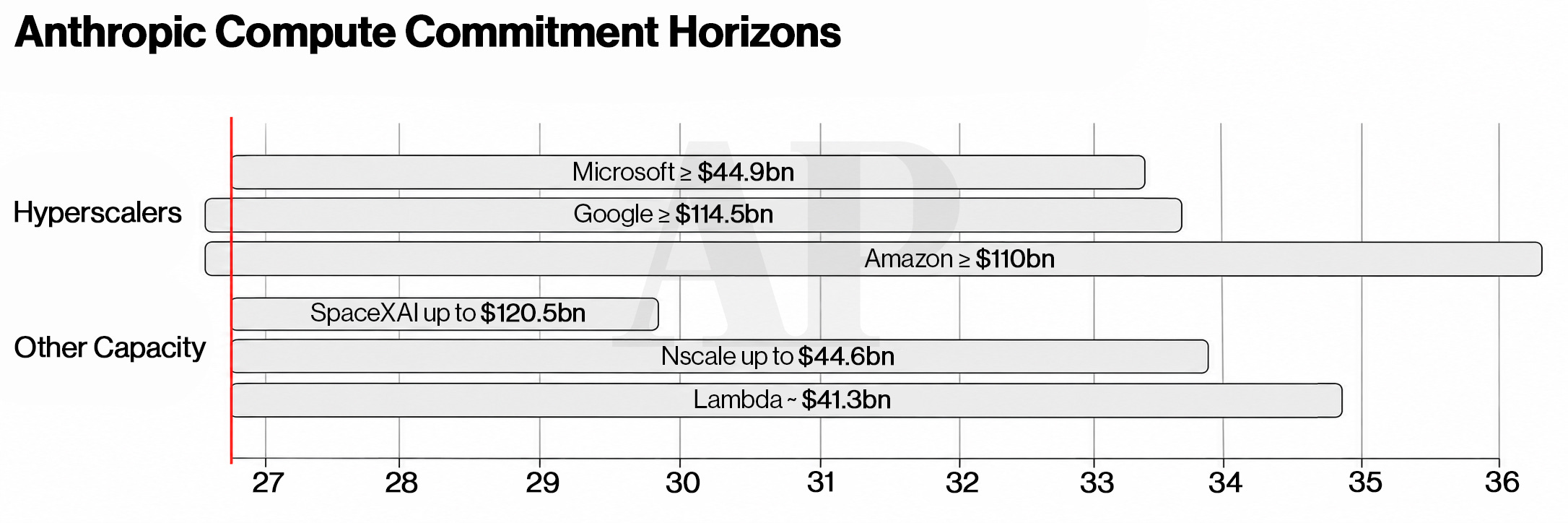
A highly attractive growth story is underpinned by the cash-flow implications of these infrastructure commitments, but it also introduces risks from these providers, who themselves face construction, funding, and counterparty risks.
This brings us nicely to our next section.
Junk Bond Rating, a Funding Risk
One of the main reasons to go public is to unlock a new funding channel: public equity sales.
Equity is increasingly becoming a funding method in the AI buildout, after debt channels have been exhausted and yields have risen sharply over the past year. Extensive debt financing can lead to cash flow and leverage concerns, but that does not mean debt channels are in the distant past. Hyperscaler debt issuance across currencies reached approximately $237bn in 2026, with issuance forecast at around $280bn in 2027. According to Union Bancaire Privée, the five major hyperscalers are expected to spend approximately $820bn on capital expenditure in 2026, against $750bn of operating cash flow. So the next step in the financing is equity issuance, which avoids debt-servicing obligations down the line, albeit at the cost of diluting shareholders.
But this is not a section to discuss the broader dynamic of the AI buildout. This memo is about Anthropic, which, in a challenging equity backdrop and high-yield environment, may face pressure from either side of the funding coin: debt or equity.
On the equity side, valuations have already compressed since the summer, and Anthropic, while not yet public, has felt that pain. Not too many months ago, the numbers being thrown around were closer to $2tn, which would have surpassed SpaceX’s historic listing at a valuation of $1.77tn, but this week’s IPO roadshow indicates a valuation closer to $1.4tn. Everything from the frontier to the ecosystems beneath them has rerated lower. Hardly the environment Anthropic would have wanted to offer in, and maybe part of why OpenAI has pushed back listing this year.
Then there is the debt rating that Anthropic may receive. In recent weeks, Blackstone told investors that Anthropic may not receive an investment-grade rating immediately after going public, which was a reversal from its previous guidance. Instead, Anthropic may receive a “high” junk rating from major credit rating agencies.
The AI lab’s prospectus sketched out its “bold but sane” plans to spend more than $800bn on computing infrastructure between now and 2045. An investment-grade credit rating is central to those ambitions, enabling Anthropic to borrow at lower rates to finance its AI infrastructure projects.
However, a designation in the double-B range would limit the pool of capital that Anthropic could tap because many insurance and pension funds are restricted from taking large positions in junk-rated borrowers. As a result, the company might need to continue relying on suppliers with high credit ratings to support its debt-raising efforts.
There are also dilution risks from equity-linked financing. Anthropic’s $146.6bn of total liquidity ($146.6bn includes $14.8bn of undrawn bank capacity) comfortably covers the $69.8bn of contractual spending due within 12 months, but does not fully fund the $447.5bn scheduled through 2030. Up to $77.0bn of additional financing under note purchase agreements (NPAs) provides a significant, though conditional, funding bridge. The facilities generally convert into equity at prices linked to the prevailing share price, with some carrying a discount. A lower valuation therefore means issuing more shares to raise the same amount of capital.
The junk-rating risk is seen as heightening IPO risks ahead of release, as pressure intensifies on Anthropic to demonstrate returns and keep debt costs in check. For equity investors, the junk-rating trajectory adds a layer of financing risk that compounds the already elevated valuation multiple.
Dot Com Analogue
There is one key analogue we see in the AI race, and maybe unsurprisingly, it comes from the dot-com era.
The first shorter analogue relates to the economics. The commercial internet took off in the mid-90s; investors correctly anticipated that it would fundamentally change the economy. A story most will know well. Key metrics for investors were website traffic, user growth, and the promise of future profitability. The business models also depended on continued access to capital.
Sound familiar?
Secondly, however, the companies that pioneered the technology in the 90s were not necessarily the ones who captured the economics. Many were caught in the internet wreckage, early fallers like Pets.com, and later other names like Yahoo, AskJeeves, and Bing. All lost out eventually to Google. Today, Google holds approximately 91% of the global search engine market.
Yet Google was not an early player in the internet race. It launched in 1998 into an already crowded market. Somewhat ironically, it was Yahoo’s decision to use Google’s technology that provided a platform to grow from and eventually swallow the market. Google’s product delivered better results through its PageRank technology and hyperlinks, and it famously kept an almost empty homepage while competitors filled theirs with ads. And most importantly, Google figured out how to monetise intent, launching AdWords in 2000 and introducing a cost-per-click advertising model in 2002.
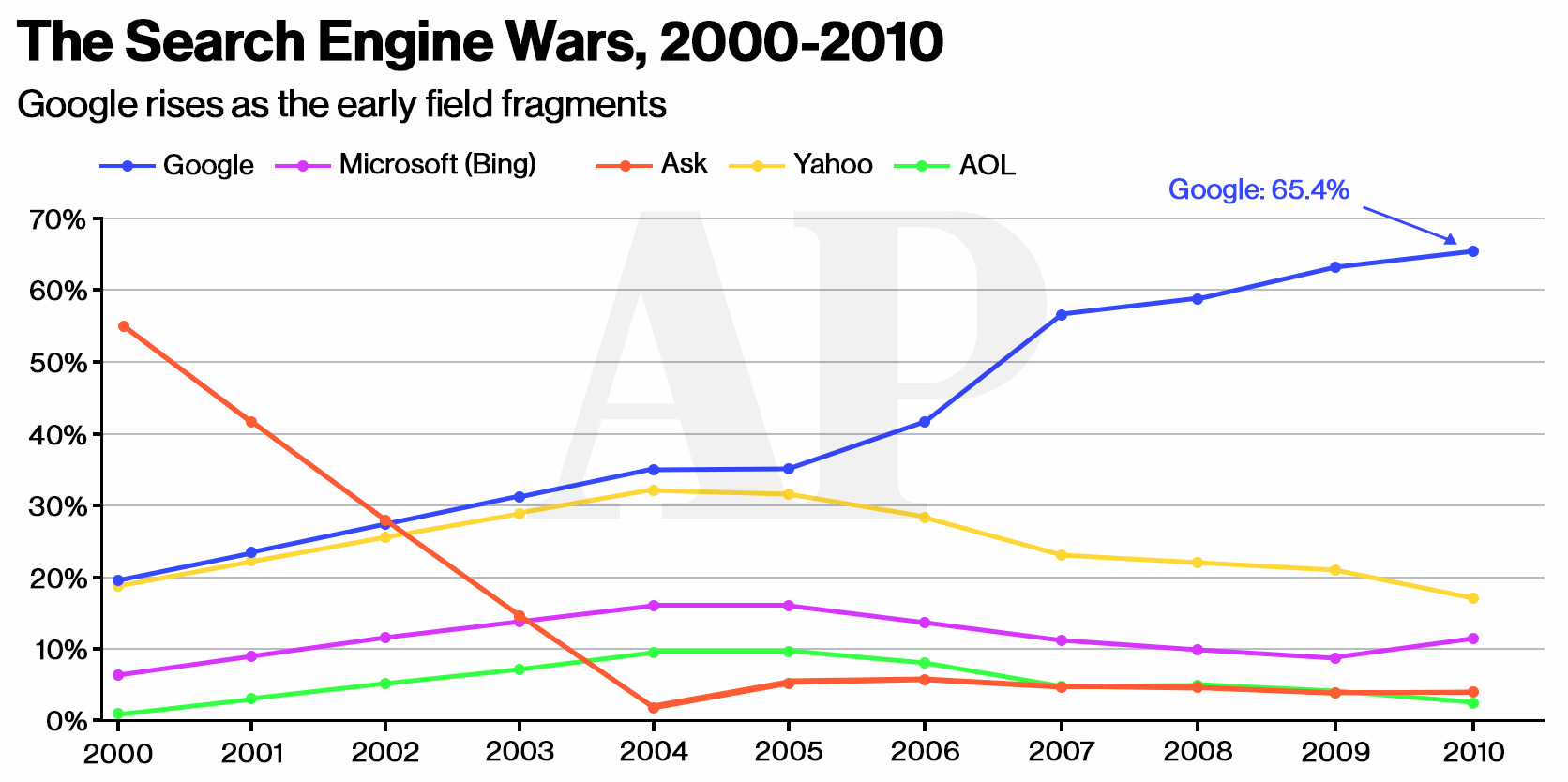
Where we see this analogue in AI today is in the variety we all have right now. From connections we speak to who use AI at far more enterprise levels than we do, there seems to be an overwhelmingly easy ability to hop from one frontier to the other as new models are released. No contracts to keep X amount of revenue locked in from enterprises. Even among consumers, moving from ChatGPT to Gemini, or Gemini to Grok, is far easier than, say, moving from Apple to Android. This is partly reflected in Anthropic’s S-1, stating that subscriptions typically run for 12 months or less.
We have three takeaways from a brief look at the dot-com era. Firstly, are we likely to see one ultimate winner in the West and one winner in the East, while everyone else fails? If so, that winner may not be the current leader, just like Google won as an outsider. If so, would buying the haystack (Anthropic, Alphabet, SpaceX, OpenAI) gain more from the eventual winner than it loses on the rest?
Secondly, the search race showed that monetisation and distribution mattered more than marginal improvements in model quality. Google became enormously profitable and stayed around for decades to come because it translated user intent into advertising revenue. For AI, the winner may be the one who can capture the economic value generated by AI, rather than who provides the intelligence. Does that come from a company that is currently pure frontier (Anthropic, OpenAI) or from a company that is building intelligence on top of an existing business model (Alphabet)?
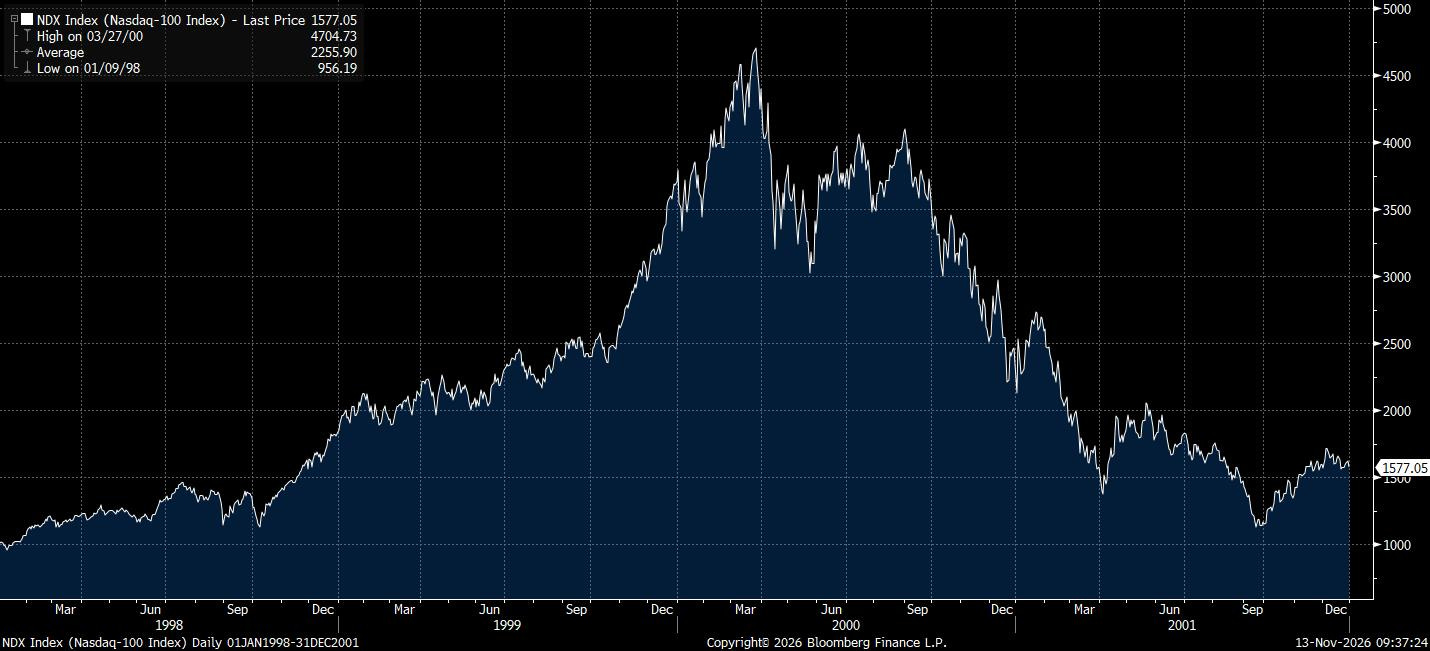
And finally, there is a not-so-nice reminder, and maybe the most important macro parallel, is that technology can succeed while investors lose money. Internet usage exploded after 2000 while the Nasdaq collapsed. Many companies risk substantial valuation compression if returns on investment disappoint. Apologies for sounding like a bear for a moment.
What’s the Trade?
Getting the AI revolution right and making money from it are two very different things. The dot-com era taught investors that lesson rather painfully. With Anthropic about to enter public markets, we see three ways to position for the next stage of the trade, but one stands out to us on a risk-adjusted basis.