

A red reaction followed the Blue Wave. Midterms delivered the expected result. Thursday delivered the selloff. Friday the recovery. By the closing bell, markets had settled somewhere between panic and relief.
We can probably skip any comments about Monday or Tuesday, which felt like the distant past by the time we put our pencils down and began to unwind for the weekend. Wednesday’s market moves validated the “Midterms don’t matter” consensus. Some initial knee-jerk moves, then a broad retracement, with the dollar as the standout move (loser) of the election results. The anatomy of an equity selloff played out in full colour on Thursday as sudden chain reactions rattled Wall Street. But more on that later.
Asia bore the brunt of the equity damage. The Nikkei fell nearly 9%, while EM stocks logged a sixth consecutive weekly decline, their longest losing streak since 2014, led by tech names like SK Hynix and Samsung. Europe was the relative outperformer. The Stoxx 600 briefly flirted with a record on Thursday before Friday’s broader liquidation pulled it lower, though it held above its 200-day moving average. The US saw the Nasdaq lead losses, while the Dow held up best.
It’s not been a great six weeks or so for funds. Crowded trades have been offloaded, and macro funds have been humbled alongside the AI whiz kids liquidated in the pain. Brazil shocks, Paris riots, and a Midterm shift have bruised even the biggest and most experienced money managers.
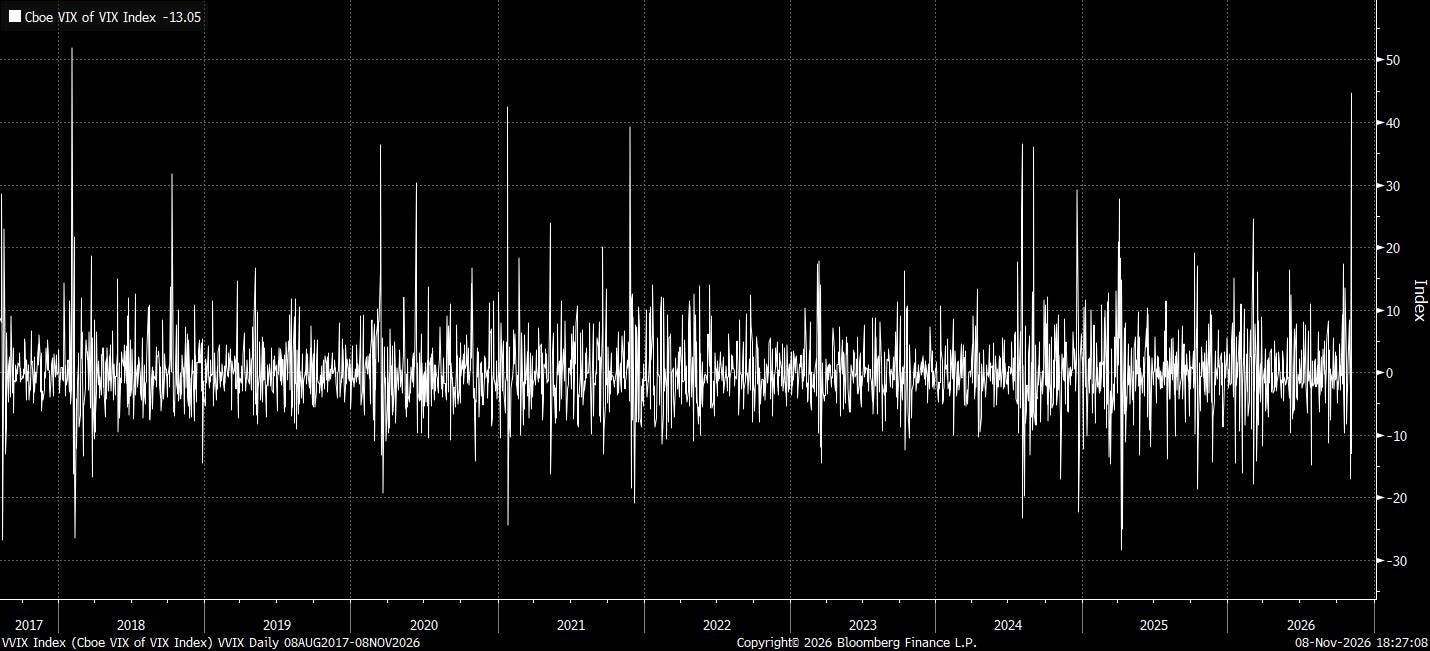
In other asset markets… USTs rallied and the curve bull steepened on Thursday, with the 2-year down about 11bps to 4.47% against about 6bps for the 10-year, which closed near 4.84%, its lowest since September 10. The front end led because the move was more about the Fed rate path than growth, as the equity rout and a 16% weekly decline in Brent took some of the inflation risk out of the December decision. Payrolls reversed part of that on Friday as the curve flattened back to reprice a potential hike.
Enough of what was. Let’s get into the guide to trades moving markets, where things stand, and where they may be heading.
“Nosedive”
“Fed Pressure, or Lack Of”
“Summary of House Views”
We’re making this week’s Week Ahead freely available to all readers. With markets digesting the midterm results and investors reassessing their positioning, we thought it was worth opening up our latest house views to a wider audience.
If you find our thinking useful, there’s plenty more where it came from. Paid subscribers receive our full research output, including macro strategy, cross-asset trade ideas, and thematic deep dives.
Start your 7-day free trial to explore the research library and see what we’re working on next.
Nosedive
To say Thursday’s selloff was anything less than brutal would be an understatement. However, how much of it was positioning and mechanical (reflexive market dynamics) and how much was a fundamental reassessment is a tough question to answer. Without wanting to sound on the fence, the answer is probably a bit of both. It’s important to distinguish near-term moves from the bigger picture of the AI trade. They could tell very different stories into year-end.
Last week’s volatility was concentrated in the AI trade, leaving its mark on the broader Nasdaq index due to heavy weights, but therefore making it difficult to conclude that this was a broad capitulation signal. Near term, we expect equity price action to be volatile as vol-control, CTA, and dealer flows drive instability. If markets experience another selloff, relief rallies are to be expected as forced selling fades, though retail appetite to buy the dip after a choppy year may be more hesitant, and slower-moving institutional books into year-end may limit relief durability.
However, once the mechanical supply clears, the drivers (mid- and long-term) of the AI trade will be 1) earnings growth and 2) how regulatory and policy adjustments under a new Democratic House and Senate affect that valuation set on that growth.
Starting with the latter, despite a swift revaluation of the trade after the midterm results, the regulatory landscape under a Blue Tsunami remains uncertain. The broad consensus is that Congressional scrutiny will increase materially, but actual legislation faces a steep path given the Trump veto threat and intra-party Democratic divisions. National security concerns about “winning” the AI race also remain. Neither Democrat nor Republican governments can risk losing what is viewed by both America and China as a technological war. These considerations can create a structural floor under the AI trade that limits how aggressively Democrats can regulate, and where bipartisan consensus is most likely to emerge.
Moving to the former, earnings growth. The indiscriminate selling on Thursday may have been hard to justify for those watching the fundamentals. It’s ironic that the year’s most severe selloff happens as EPS growth in the S&P 500 nears last quarter’s 34% gain. But markets have looked past the positive revisions and focused instead on 2027, citing political risks as a growing headwind.
Yet, with our belief that regulatory risks are currently overstated, we find this fundamental reevaluation hard to square, and our team expects earnings to remain strong in 2027. That is not to say the next two years will have the same characteristics as the previous four years, when anything AI- or bottleneck-related outperformed significantly. As our friends and the excellent team at Citrini Research put it last week, “this may be the end of the trade (as we know it).”
As for the macro environment that US equities find themselves in, it pulls both ways. The greater-than-expected hiring in October supports the notion of a healthy economy and consumer, a tailwind that will keep underpinning earnings strength. Although Friday’s jobs surprise could give the Federal Reserve ammunition to raise interest rates, policymakers have been clear that inflation is their primary focus right now. Wage growth was better than projected, but has been in a downtrend for some time, showing little evidence that the labour market is an inflationary force right now. Oil faces a similar two-way street. Improving supply fundamentals argue for lower prices, while unresolved Iran risk limits the downside and keeps energy relevant for inflation and rates.
It leaves us with a muddy picture into year-end, and one that favours a more tactical approach rather than a clean risk-on or risk-off call. The initial positioning shock may be behind us, but the next phase is likely to be characterised by portfolio rebalancing, choppy index-level trading, and greater dispersion beneath the surface. We favour companies with strong balance sheets and visible earnings growth over those parts of the AI complex increasingly dependent on external funding. For a more durable rally to emerge, volatility needs to settle, correlations need to fall, and investors need greater clarity on both the regulatory outlook and the financing of AI capex. Until then, we expect trading ranges punctuated by sharp relief rallies rather than a sustained V-shaped recovery. Opportunities will exist, but we suspect they will increasingly be found beneath the index rather than in it.
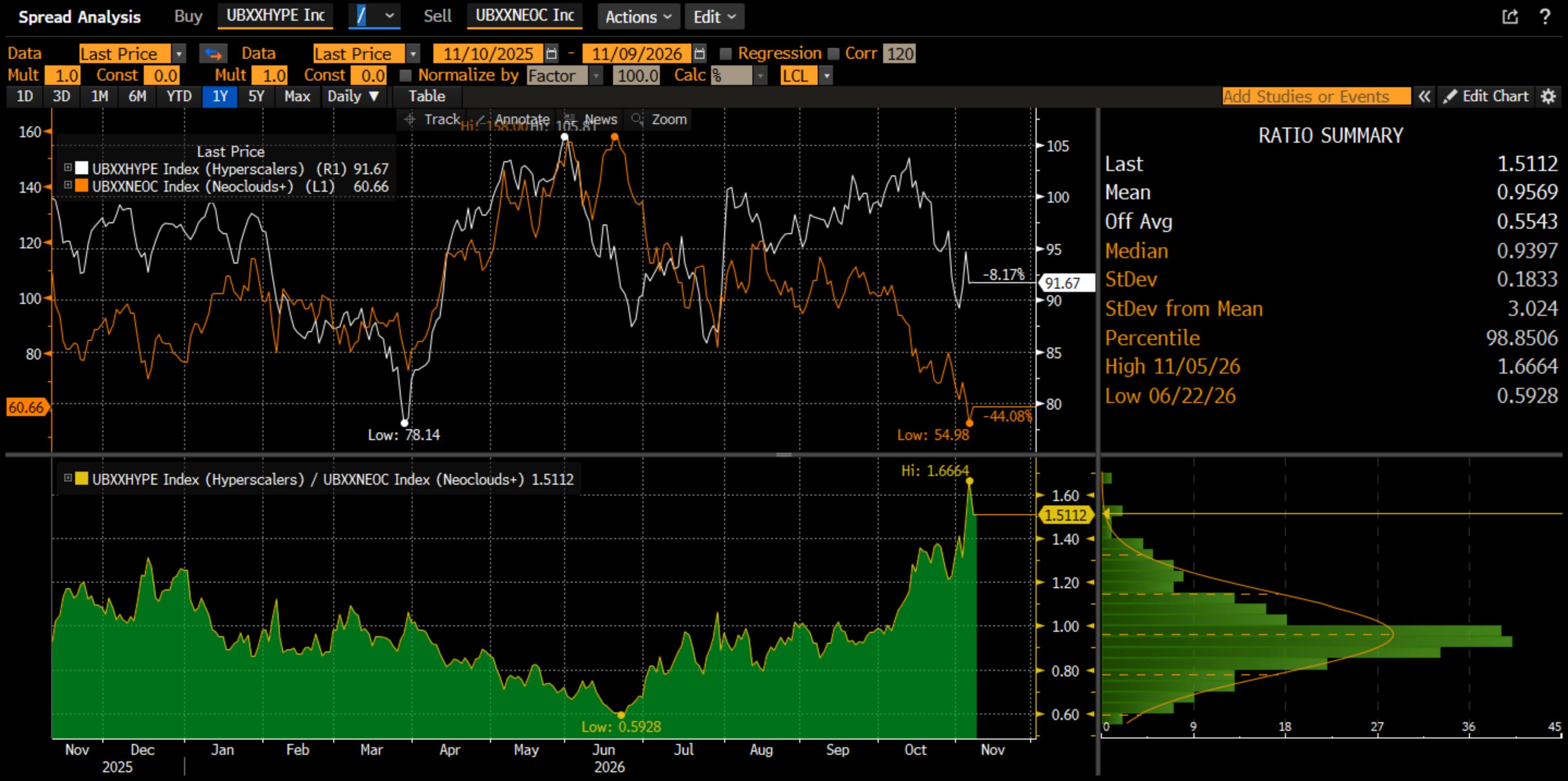
Returning to a tactical trade idea that we expressed recently, on October 19, we wrote: “Long hyperscalers against short Neoclouds could be a good pair trade in the coming weeks, one we see benefiting in both broad tech upside and downside scenarios.” We still believe this remains a strong tactical expression. One Bloomberg headline stated it eloquently last week: “big tech soars on bet Dems will save AI spenders from themselves.” We continue to favour the relative performance of hyperscalers over Neoclouds, particularly as greater scrutiny of AI capex and financing conditions should reinforce the divergence in earnings visibility, balance sheet strength, and valuations.
Fed Pressure, or Lack Of
While most of last week’s attention focused on equity moves, another consideration looms for midterm knock-ons.
It’s no secret on the Street that Trump has his views on the Fed and likes to throw his weight and opinions around. But with the Democrats’ victories last week, the central bank’s new landscape may limit President Donald Trump’s ability to influence its leadership.
The Senate confirms presidential nominees to the Fed’s Board of Governors, leaving Trump to nominate a Powell replacement (the only scheduled vacancy before Trump leaves office) acceptable to Senate Democrats, or leave the position unfilled. This also has implications for Trump’s pursuit of removing Fed governor Lisa Cook, whom he likely wanted to replace with another dove (“puppet”) on the committee.
We believe this shift in the landscape may lead to a smaller Fed board, with any vacancy (Powell for now, with potential for further vacancies to come to fruition) remaining unfilled.
For Warsh, this may not be entirely unwelcome. He has already shown a willingness to challenge the status quo at the Fed, and a smaller Board of Governors could give the Chair greater influence over the direction of monetary policy. His historically hawkish leanings have also become more apparent in recent months, with September’s 25bp hike demonstrating a willingness to push back against political pressure from the White House.
There is, however, an element of self-interest to consider. Warsh’s term as Chair runs until May 2030, well beyond Trump’s departure from office. Should he wish to serve a second term, the support of a (potentially) future Democratic administration and Senate may prove more valuable than maintaining favour with the current occupant of the White House. That changes the political calculus, potentially giving Warsh greater room to pursue a more hawkish policy stance without the same concern for presidential intervention.
Yet the irony is that, just as the election may have given Warsh greater freedom to raise rates, it may also have reduced the need to do so. The economic implications of the Democratic sweep appear modestly disinflationary, at least in the near term. Potential changes to government spending and the sharp reversal in oil prices over the past fortnight add to that disinflationary impulse.
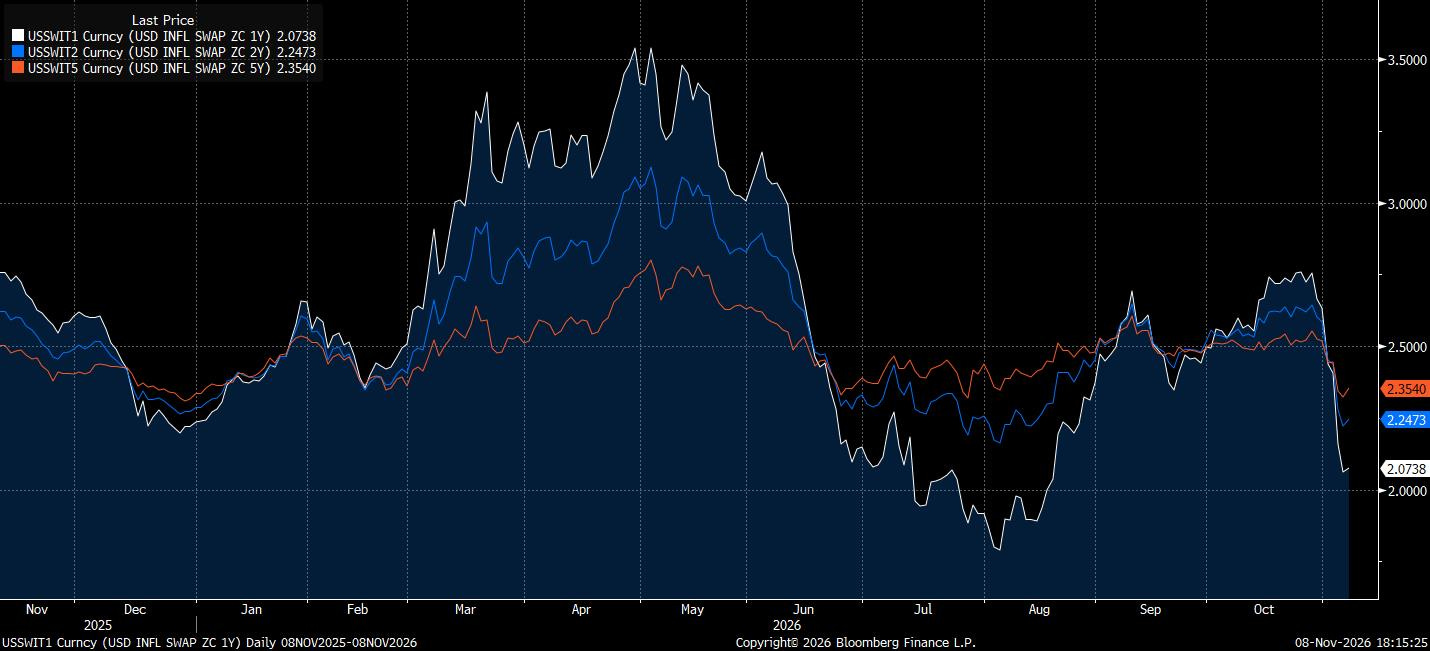
Markets have been quick to recognise this shift. One-year US inflation swaps have fallen to around 2.07%, with two- and five-year measures declining to 2.25% and 2.35%, respectively. The particularly sharp move at the front end suggests investors are reassessing the immediate inflation outlook, even as Friday’s strong payrolls report keeps the prospect of a December hike firmly on the table.
We suspect the distinction between the Fed’s willingness to tighten and the economy’s need for further tightening will become increasingly important into year-end. Warsh may now have more political room to pursue his preferred policy path, but with energy prices falling and the investment outlook facing greater uncertainty, the case for materially higher rates could become harder to sustain. The political constraints on the Fed may have eased just as the economic constraints begin to tighten.
Top Trade Ideas and Views
Curves
France-Germany 10s30s relative steepener (here)
Rates
Fed December hike, BOJ January hike
ECB to hike once more through to year-end (policy mistake). Fading longer-term hike pricing via long 2-year Bunds (entry at 3.18%)
UK, short SFIZ6Z7
France, buy 5-year French sovereign CDS protection and receive the 10-year OAT‑Bund spread (here)
Currencies
EUR/USD 3-month 1.10 put (here)
EUR/USD 3-month 1.10/1.1250/1.15 reverse iron butterfly, 1.15% premium (here)
Equities
Long hyperscalers, short Neoclouds (here)
See you soon,
AP
The tension I keep noticing is S&P EPS growth near 34% while the selloff prices 2027. For the hyperscaler versus neocloud split, how much of the gap is financing structure rather than earnings visibility? Debt-funded capex looks like the cleaner dividing line.