

This article is co-written alongside Michael Brown, market strategist and frequent media commentator.
Keir Starmer is out, which is to say Westminster has once again managed to produce a surprise everyone had spent weeks preparing for.
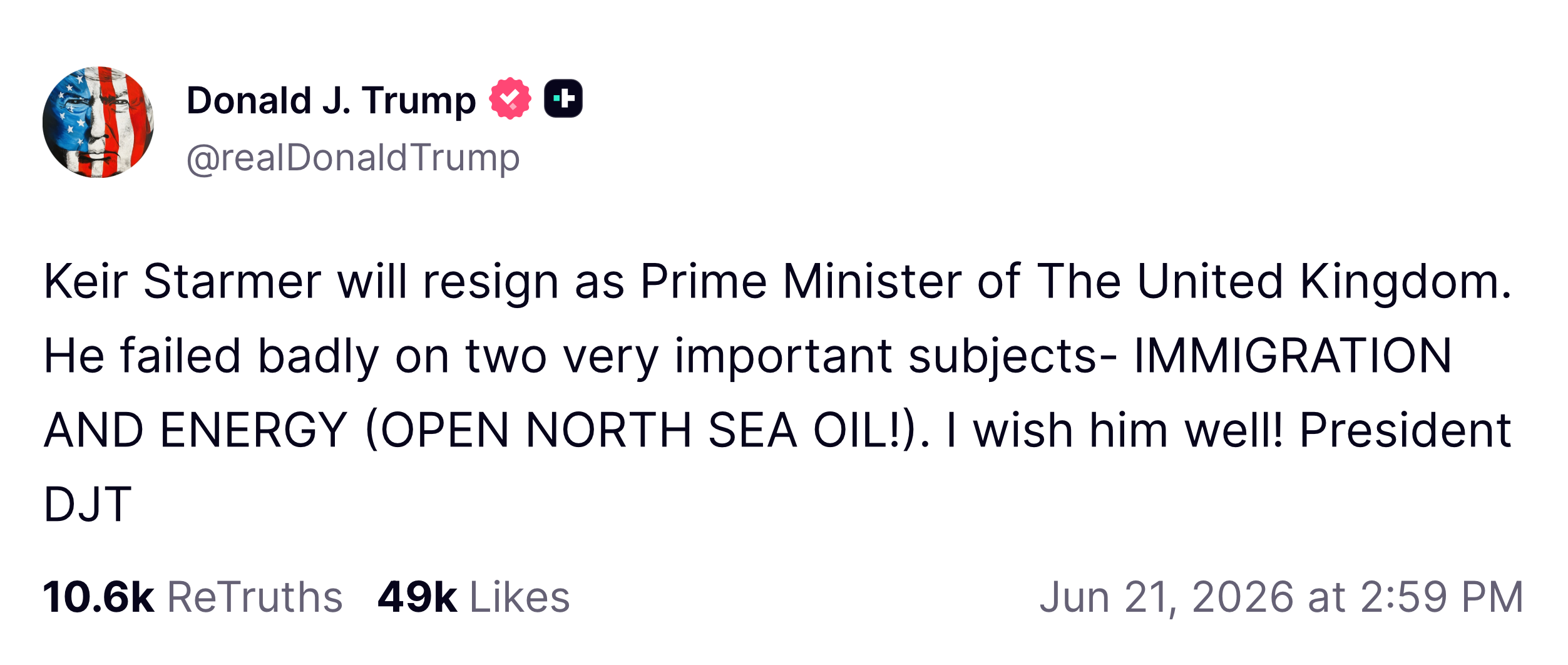
The exit was priced before it happened, and the market reaction since has reflected that. The Makerfield byelection gave Andy Burnham his route back to Westminster, and Donald Trump, never knowingly under-briefed on another country’s political instability, had already previewed the ending from across the Atlantic the weekend prior.
Andy Burnham looks set to replace Keir Starmer as Labour leader and prime minister, thus becoming the seventh occupant of the “top job” in just the last ten years. That said, while removal firms busy themselves once more in Downing Street, Burnham will likely face the same challenges his predecessors have faced and quickly find himself boxed in on all sides. While it is not confirmed yet, a lack of competition and polling websites suggest a near certainty that Burnham takes No. 10.
From a political perspective, there is clamour among Labour MPs to shift leftwards, to counter an insurgency in the polls from the Greens, and to provide an offering that is distinctly different from Nigel Farage’s reform. Such a shift, if it were to pan out, would likely tee up a “populist left” vs “populist right” contest at the next election, due to be held in 2029, and unlikely to be called sooner, considering the current parliamentary arithmetic.
Burnham is more interventionist in tone, but he has also tried to reassure markets. He has pledged to stay within existing fiscal rules and honour Labour’s promise not to raise taxes on working people, while arguing that privatisation and deregulation have created inefficiencies, especially in housing and utilities. The view is enough to make gilt investors nervous, but not yet to make them panic.
Gilts sold off the week after Burnham’s emphatic Makerfield victory, with the 10-year yield pushing higher and the long end once again becoming the most sensitive part of the UK political weather map. Sterling weakened too, which was the more revealing move. In normal circumstances, higher yields should support a currency. When yields rise and the currency falls, the market is not rewarding policy credibility. This has been much of the same reaction that we saw following the most recent ECB “policy mistake” (After You, Christine).
There is an echo of 2022, albeit on a far smaller scale. No Liz Truss moment has played out. No forced selling or pension-fund stress. However, markets are marking up the chance that the next prime minister might be more relaxed about borrowing, more willing to test the fiscal rules, and more tempted to treat the bond market as a political opponent rather than a funding source.
A lot was already in the price. Starmer’s authority had been fading for months. The UK was already carrying a political risk premium. The gilt market was already dealing with heavy supply, sticky inflation anxiety, weak growth, and a public-sector balance sheet with very little margin for error. Burnham did not create those constraints, but he inherits them for his reign (Gilt Trip, Starmer Drama).
In Hock, Whether He Likes It or Not
“We’ve got to get beyond this thing of being in hock to the bond markets.” — Andy Burnham, September 2025. For Andy, this may instead be the factor he has to live by. If Truss left us with anything, it’s that you have to have credibility with the bond market to survive.
That last line may be the constitution of modern British fiscal politics, a line not written down but enforced daily at the 8 a.m. open by gilt traders, liability-driven investors, overseas reserve managers, and anyone else absorbing a round of long-duration UK paper.
Burnham appears to understand this, and his tone has changed since that remark in September. In the wake of the market wobble last week, Burnham moved to contain any concerns by bringing in what we could call an A-list of fiscal personnel: former Bank of England chief economist Andy Haldane, the former Goldman Sachs economist and Conservative government minister Jim O’Neill, and the former head of the Office of Budget Responsibility Richard Hughes. A team of economic centrists, so to speak. Bringing in people with credibility around monetary policy, fiscal rules, and institutional economics sends a clear, positive signal.
Bringing in fiscal adults is in stark contrast to Starmer’s efforts (sorry, Rachel).
Markets can tolerate redistribution. They can tolerate higher taxes. They can even tolerate selective intervention if it is funded, explained, and tied to a plausible growth story… but talking about growth in a country that has become allergic to it does sound strange. What they cannot tolerate is unfunded ambition on ideological views alone.
That is where the Truss comparison is useful up to a point. Truss tried to tell markets that credibility could be asserted. Burnham’s challenge is to show that credibility can be borrowed, at least initially, from the institutions and people around him. Fiscal rules, OBR oversight, Bank of England independence and a serious chancellor are the guardrails.
There is also little to no desire among the general population for broad-based tax hikes, unsurprisingly, given that the tax burden is already on its way to a record high. And, make no mistake, the days of “just tax someone else” are now behind us. Wealth is too mobile, and the tax base far too top-heavy, for that to be a coherent strategy anymore.
Substantial additional borrowing is also off the cards, whether within or outside the fiscal rules, or whether dressed up as “borrowing to invest” or suchlike. The nub of the matter remains that higher borrowing is just that, no matter the clothing it wears, and that greater Gilt issuance would increase not only the fiscal risk premium that the UK must pay in the form of higher yields, but also the inflation risk premium that is paid.
While Burnham’s political capital will never be greater than the moment he enters No. 10 for the first time, plenty of fiscal stumbling blocks have already emerged.
The ‘Defence Investment Plan’ requires £4.7bln of funding that has not yet been found, while last year’s Budget was conditioned on departmental spending cuts and pre-election tax tweaks that always looked somewhat far-fetched. As a result, any honeymoon period that Burnham might’ve been expecting is likely to prove relatively short-lived.
Pre-Budget trial balloons will likely start flying almost as soon as Parliament returns from recess in September, beyond which Burnham’s choices will likely boil down to either growth-negative tax hikes, or politically unpopular spending cuts. With that in mind, any near-term relief experienced either by the GBP or Gilts is set to prove relatively short-lived, as after a summer of relative stability, may come yet another tumultuous autumn.
Where We Go From Here
The immediate market reaction also tells us what investors are really worried about. If we take a look at sovereign default swaps, fiscal irresponsibility is not showing up as it did in previous instances such as Covid and the Truss moment.
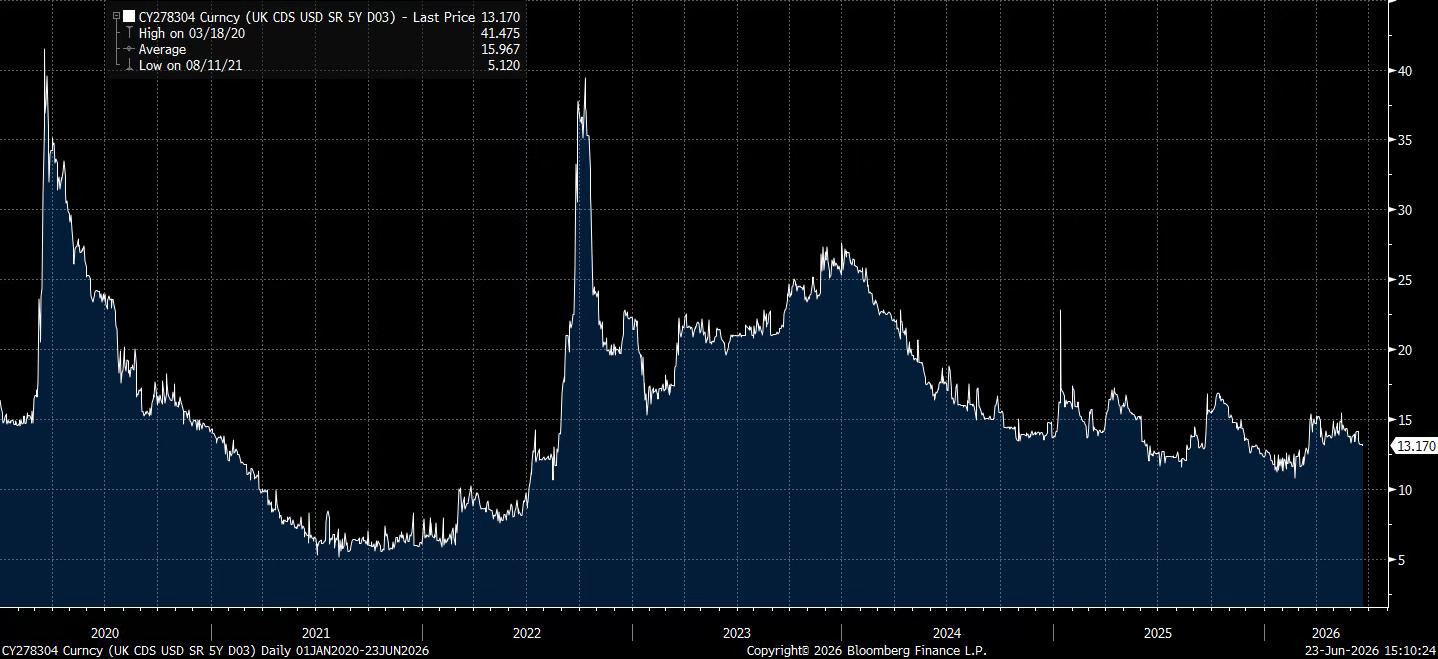
The concern is subtler and will show up more in yields, the curve, and currency markets.