

Software and private credit have spent much of this year taking turns as the market’s forgotten risk. Every few weeks, the narrative disappears beneath whatever crisis is dominating the headlines, only to resurface a little larger than before. War in the Middle East, negotiations, a hawkish new Federal Reserve chair… all have taken their turn pushing it aside. The private credit cockroach, however, never left the kitchen.
We first explored this theme in early February, as AI disruption risk became front and centre for software investors and private credit markets. As SaaS valuations compressed, attention naturally turned towards the lenders that had spent the better part of a decade financing those businesses at generous multiples.
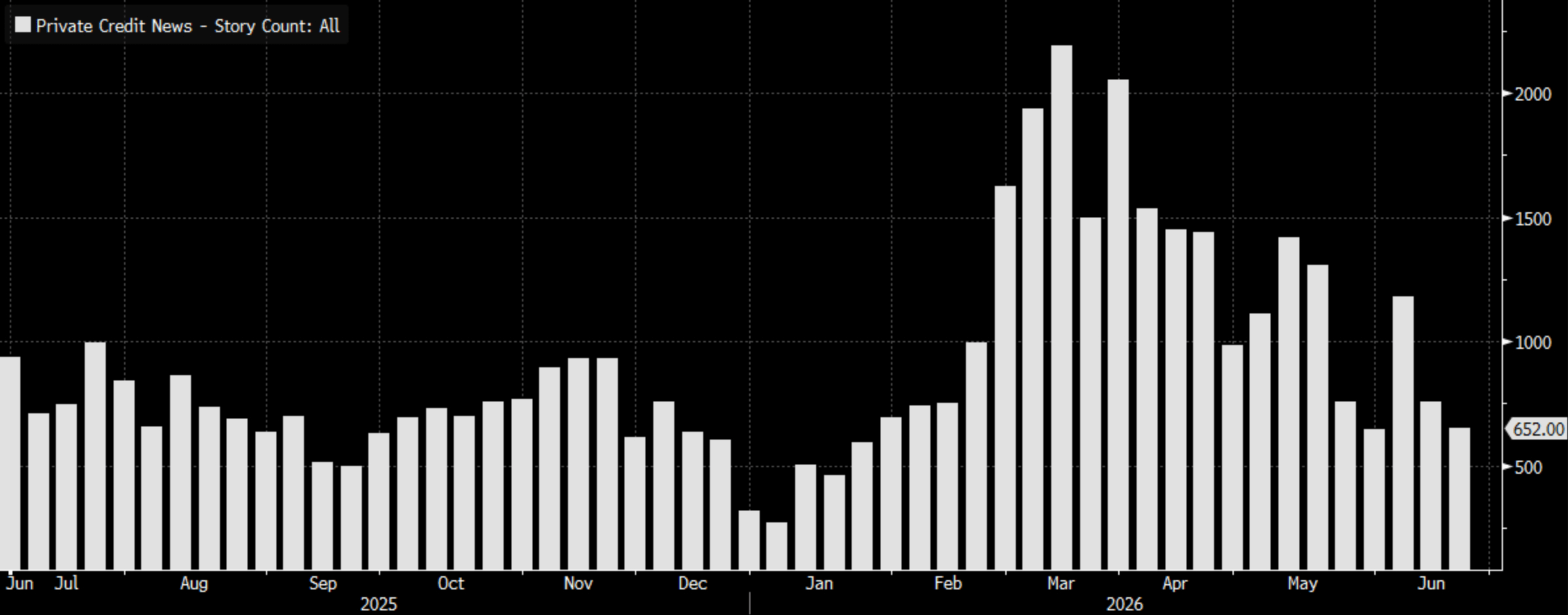
Our focus was less on software equities (which had already experienced a significant downturn themselves) and more on the companies behind them. Alternative asset managers (Alt AMs) and business development companies (BDCs) had found themselves under scrutiny as investors questioned how resilient private credit portfolios would prove in a rapidly evolving technology landscape.
Nearly five months have passed. Now, we’re seeing a new trade emerge around private credit risks, outside of the SaaS-pocalypse and Loan-mageddon.
Software-as-a-Selloff
If you missed that piece or simply need a refresher before we move the story forward, it is worth reading below.

Since publication, our short basket of alternative asset managers and BDCs has returned approximately 19%, validating much of the original thesis.
Several of the largest listed alternative managers have reported increased redemption requests as institutional investors become more selective about committing fresh capital to illiquid strategies. That itself is not indicative of a run on private credit, but it does represent a growing shift in behaviour. After years of almost indiscriminate inflows, allocators are beginning to ask harder questions about liquidity, valuations, and borrower quality.

The software story has evolved as well. Rather than indiscriminately selling anything with recurring revenue, investors have begun separating businesses with genuine competitive moats and AI implementation ability from those without. Companies built around proprietary datasets, embedded workflows, or regulatory complexity have proved far more resilient than generic application software.
The original software sell-off may have been only the first-order effect. Credit cycles rarely announce themselves all at once. Equity investors react immediately; credit investors tend to discover the damage in instalments.
Which brings us to today. The market is asking a different question altogether: If private credit becomes the problem, who ultimately owns the loans?
Insurers
Where we’re starting to see this trade pick up on Wall Street relates to insurance companies. More specifically, it relates to the credit default swaps linked to these companies.
We could continue this article by explaining private credit markets or credit default swaps. Fortunately, we have a catalogue of primers published across our research, and both topics have been explained in depth previously.


We move, then, to the trade itself.
Private credit risk has been building for some time. What matters now is that markets are beginning to identify where the next pressure point might emerge in public markets: Insurance companies.
At first glance, this may seem an unlikely focal point. Insurers are not originators of software-linked loans in the way that BDCs are, nor are they the architects of private credit structures like Apollo (APO US), Ares (ARES US), KKR (KKR US), Blackstone (BX US), or Blue Owl (OWL US). They do not sit at the obvious centre of the narrative — which is precisely why they merit attention.