

The market is hardly short of talking points. Oil is back, front and centre, of the macro story, leading inflation expectations higher, rates higher, and pressuring equities lower. Yields across the curve continue to rise. Momentum themes and the core of today’s bull market, the AI trade, are all weak.
At least, that was the narrative to start this week. Following an unusual presser from Warsh after the FOMC held rates, and an AI capitulation leading to Wall Street’s golden child of the AI trade, Leopold Aschenbrenner, on the receiving end of a forced liquidation (just for Citadel’s Ken Griffin to sweep up his holdings), people are asking, “Is the bottom in?”
It may be. Despite the short-term shift, though, we still prefer the question of “Where are the safe havens?” And that answer isn’t immediately obvious. Currency havens offer little respite. Treasury auctions for 5-year bonds earlier this week tailed with bidders AWOL, while the reception for the 2-year signalled no broad shortage of Treasury demand in policy-sensitive paper, where duration risk is limited. And even though equities (S&P 500) may only be 1.5% below highs set on June 2nd, equity exposure in portfolios feels anything but calm.
So, what next? August is now upon us, a seasonally low period of market liquidity. We’ve spoken already about recent Fed and ECB actions; we’ve touched on shifting portfolio exposure towards financials and our search for single-stock catalysts in global markets; and we’ve highlighted idiosyncratic risks in debt markets on our home turf.
It felt right to, instead, turn our attention specifically towards two questions:
What factors are driving the AI trade other than a hawkish rates environment?
Do the unusual events of this week signal short-term relief for crowded themes?
Rates Are Only Part of the Story
The easiest explanation for momentum weakness is the same story that has kept markets busy since March. Higher oil raises inflation expectations, higher inflation expectations raise yields, higher yields reduce the present value of the distant cash flows on which long-duration technology valuations depend.
If this were simply a rates shock, one would expect growth stocks to fall in tandem with the broader market. Instead, the market has become increasingly bifurcated. The equal-weight S&P 500 has reached new highs while the main index has fallen and hundreds of individual stocks have advanced on days when the headline index appeared becalmed.
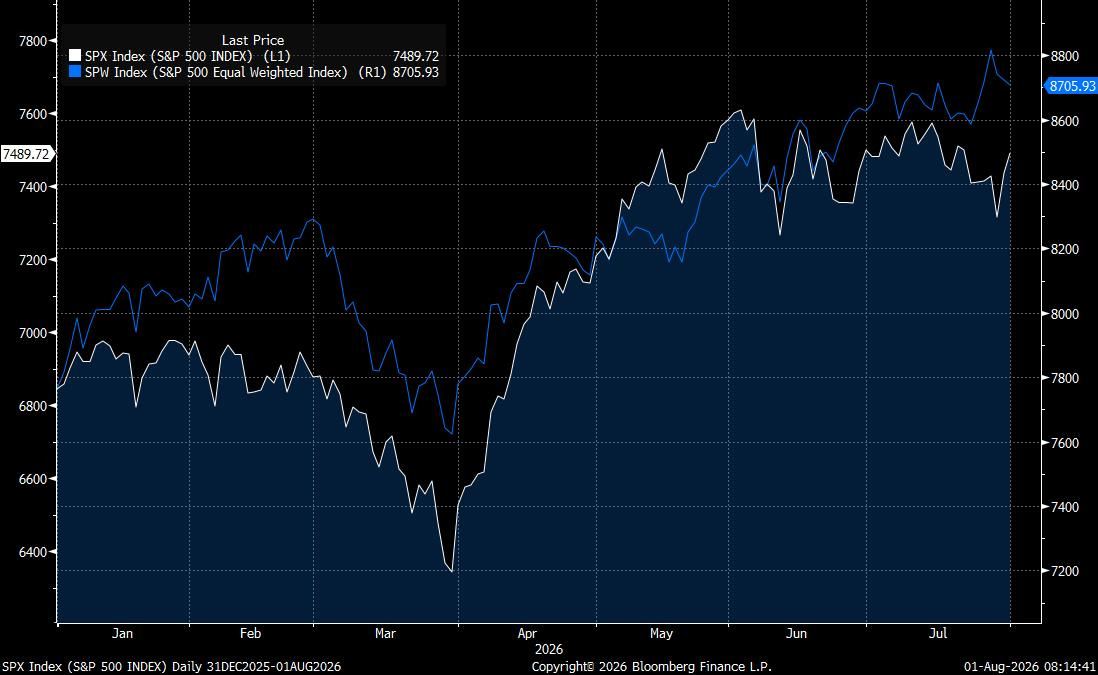
Rates may have lit the match. But what is now burning through the AI trade is a broader reassessment of spending and returns. We call this “The Three Cs.”
Capex. China. Credit.
A full autopsy of the AI selloff is incomplete without exploring each.
Capex - Unambiguously Bullish No More
For much of the past two years, rising capex was treated as evidence of rising conviction. A hyperscaler announcing an upward revision to its investment plans was seen as confirmation that demand remained strong. Yet, investors no longer treat spending as unambiguously bullish. A quick rundown of recent earnings/outlooks highlights this.
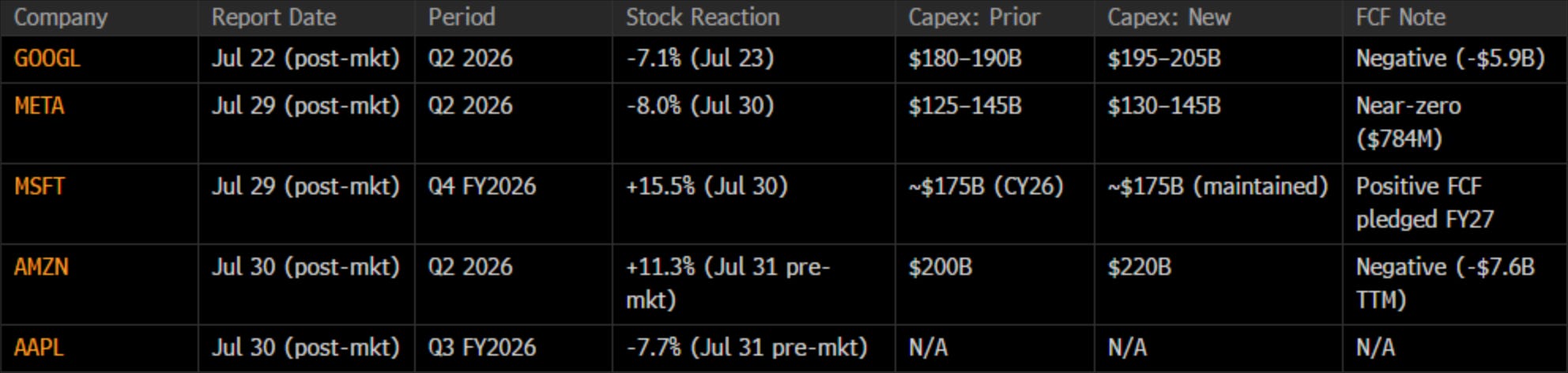
Alphabet (GOOGL US) was an early warning this quarter. Underlying operating results were strong, but another increase in expected capex was received as a liability rather than a sign of confidence. The market’s concern is that the amount of capital required to maintain leadership continued to grow faster than the evidence of monetisation.
Meta (META US) provided the clearest example of what the market doesn’t want to see. Advertising remained resilient, but another increase in capex arrived alongside collapsing FCF. Again, the concern here is that investment is accelerating faster than management can demonstrate where the eventual returns will come from.
Microsoft (MSFT US) offered the opposite case. Capex remains high, but accelerating Azure growth and a sharp increase in paid Copilot adoption provided tangible evidence that AI investment is already translating into revenue. The market will tolerate the spending because Microsoft showed both monetisation and flexibility, including an ability to slow infrastructure investment if demand begins to cool.
Amazon (AMZN US), however, showed that the market has not rejected higher AI spending altogether. It raised its capex outlook again, and FCF turned negative (the same story as peers), but the strongest AWS growth in more than four years gave investors a credible demand story against which to judge that investment.
Apple (AAPL US) remains the outlier. Rather than participating in the infrastructure race, the company continues to consume technology developed elsewhere, which leaves capex low and cash available for shareholder returns. That relative discipline has helped Apple remain less volatile than other names. Yet the latest selloff showed that Apple is still not immune to more conventional concerns around guidance and supply constraints, even if they are more fiscally disciplined than other tech names.
In short, if markets suspect that revenue growth can only be sustained by using an ever-larger share of FCF, capex will be the killer of share price. Tech still has to answer to markets whether the incremental revenue generated by the next dollar of investment is sufficient to justify it.
There is an uncomfortable asymmetry emerging. If hyperscalers maintain or raise spending, investors worry about FCF and returns. If they slow spending, investors worry about the earnings outlook for AI beneficiaries. More capex is no longer unambiguously bullish. And less capex would not necessarily be bullish either.
China - Changing the Calculation
The second pressure is competition, particularly from China, turning the debate away from investment payoffs and towards underlying assumptions of an AI buildout.
The release of Moonshot’s Kimi K3 model revived the questions posed by DeepSeek early last year: How much infrastructure is really required to produce a competitive model, and how durable are the economics of the incumbent AI stack if capable models can be developed or deployed at lower costs?
While much of the debate centres on national security risks to US leadership, a market-relevant question for us to answer concerns capital intensity. The bullish AI investment thesis has rested, in part, on the belief that increasingly capable models require exponentially more compute. If improvements in model architecture and open-source development allow users to achieve similar outcomes with less expensive hardware, that relationship between intelligence and capital expenditure narrows.
We can get our little AI friends to create a visualisation of this relationship.
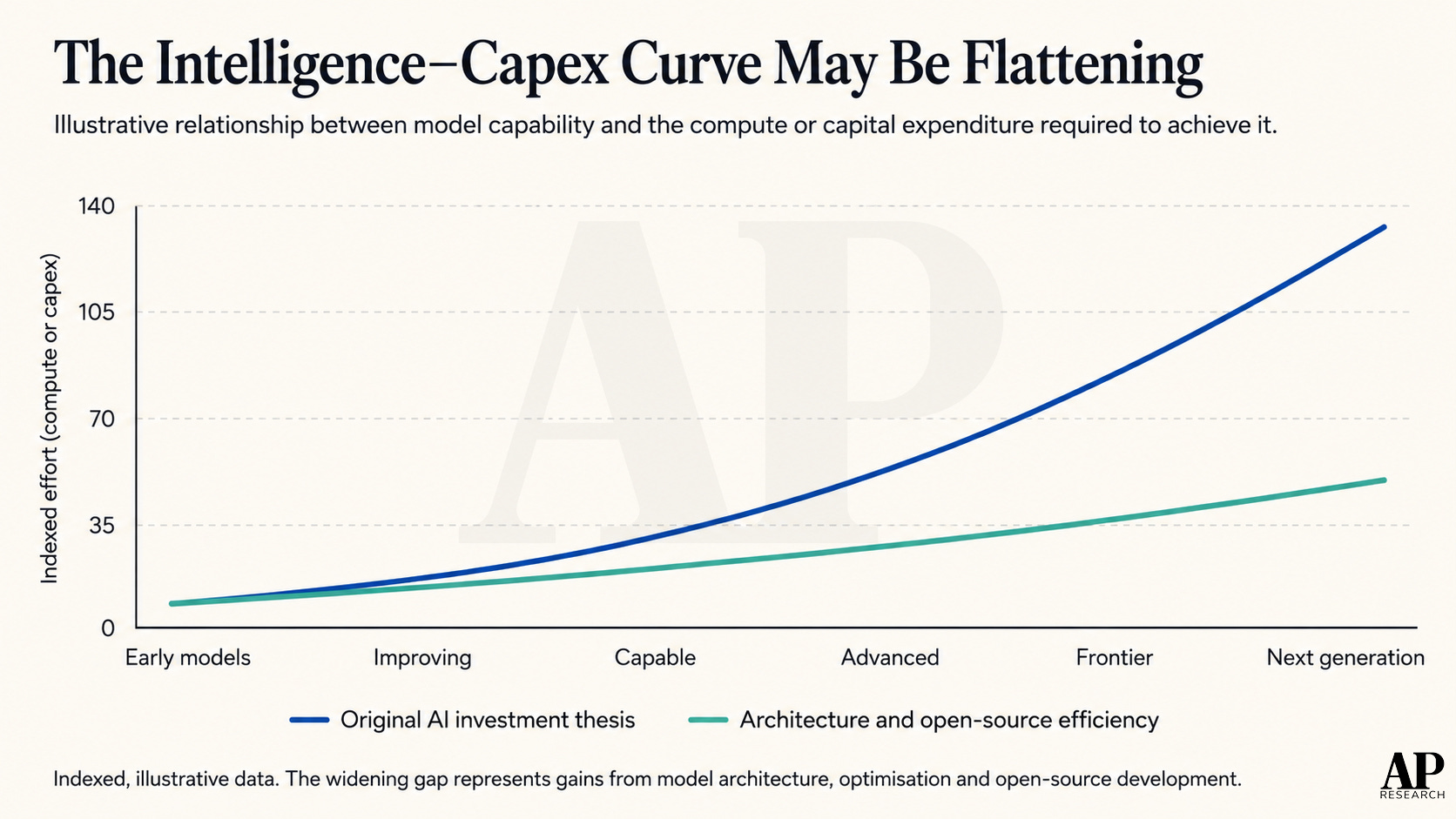
Some argue that cheaper models do not necessarily mean less aggregate AI demand. Falling costs can broaden adoption and increase usage. But as far as the market is concerned with that assumption, there remains a timing problem. The infrastructure is financed today and built today, yet much of the demand expected to justify it remains forecast rather than realised. This creates a vulnerability whenever technological progress appears to reduce the amount of hardware required per unit of useful output.
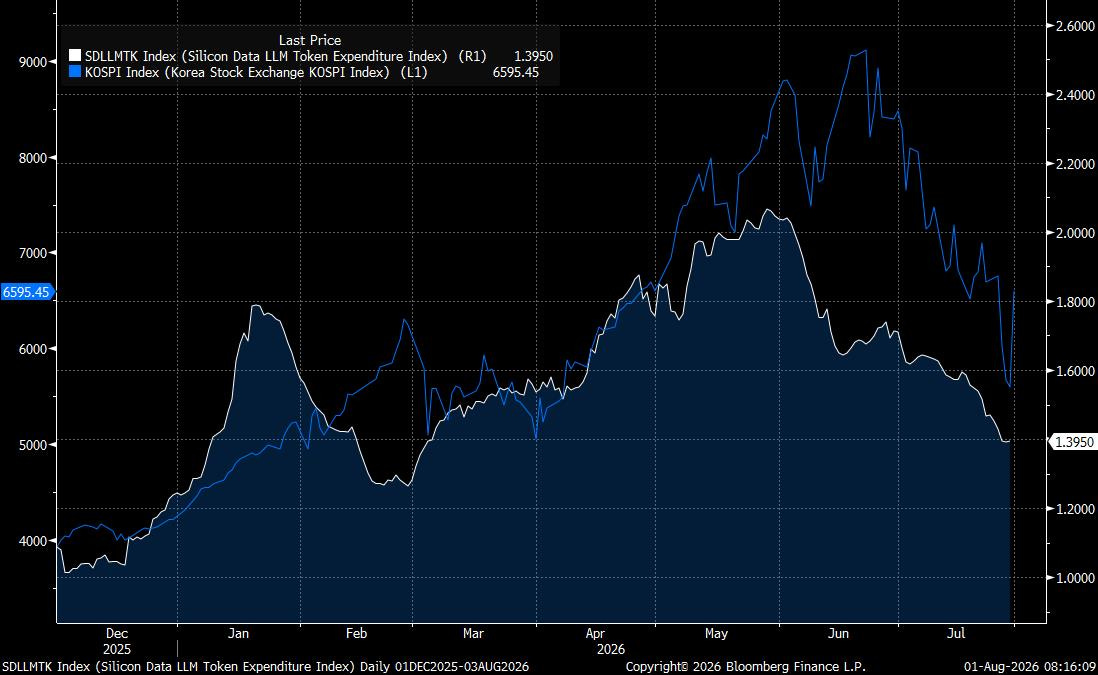
A similar issue is appearing further down the supply chain. Progress, for example, in Chinese deep-ultraviolet lithography equipment (used for chipmaking), combined with the expansion of domestic memory producers such as CXMT, force the question of durability on the industry’s moats of today. This is another factor behind a broad semiconductor selloff. The most expensive names, the most crowded positions, the companies perceived to face the greatest risk of Chinese substitution have generally suffered the largest declines.
We also have to call into question the revenue assumptions. As users gain access to cheaper models and more efficient inference, AI adoption can be viewed as bullish, but bearish for the companies attempting to monetise each unit of compute. An index of large-language-model token expenditure has recently continued to weaken, consistent with customers migrating towards lower-cost options.
The optimist has plenty of history on their side. 1) Falling hardware costs brought computing to the household. 2) Collapsing storage prices created an almost limitless appetite for data. 3) Cheaper bandwidth enabled streaming, cloud software and the modern internet economy. In each case, lower unit costs created uses that had previously been uneconomic.
Yet the investment paths of history do not always deliver the intended results. Hard-drive capacity exploded while manufacturers consolidated and struggled to earn attractive returns. Telecom operators financed the networks over which software platforms captured much of the value. The current market assumption is that those funding the buildout reap the rewards, but history’s example is hardly dismissible right now. Cheaper intelligence could produce enormous growth in consumption without guaranteeing that the companies financing the infrastructure earn returns commensurate with the capital committed.
If the price of intelligence falls faster than usage rises, the companies funding the buildout may find themselves generating less revenue per unit of capacity at a time when depreciation and financing costs are accelerating. That shockwave would travel through the entire chain.
And on financing…
Credit - Equity Concerns Become Financing Concerns
Maybe it comes as no surprise that credit risks feature in this article.
AI investment has become an interconnected web of chip suppliers, cloud providers, start-ups, infrastructure companies, and financing vehicles. One participant invests in another, which commits to purchase capacity from a third party, which then uses those commitments to finance additional construction. “Circular financing...” Explaining such feels like the below.

Young industries frequently require creative financing, especially when demand is outpacing existing infrastructure. Circularity, however, can become dangerous when valuation depends partly on the continued spending of others. The widening of CDS spreads across parts of the AI complex, therefore, deserves more attention. Equity investors can debate whether vendor financing deserves a higher multiple or a lower one. Neither will stop credit markets from analysing the balance-sheet risk.
Big tech is widening, with clear inflexion points happening in July…
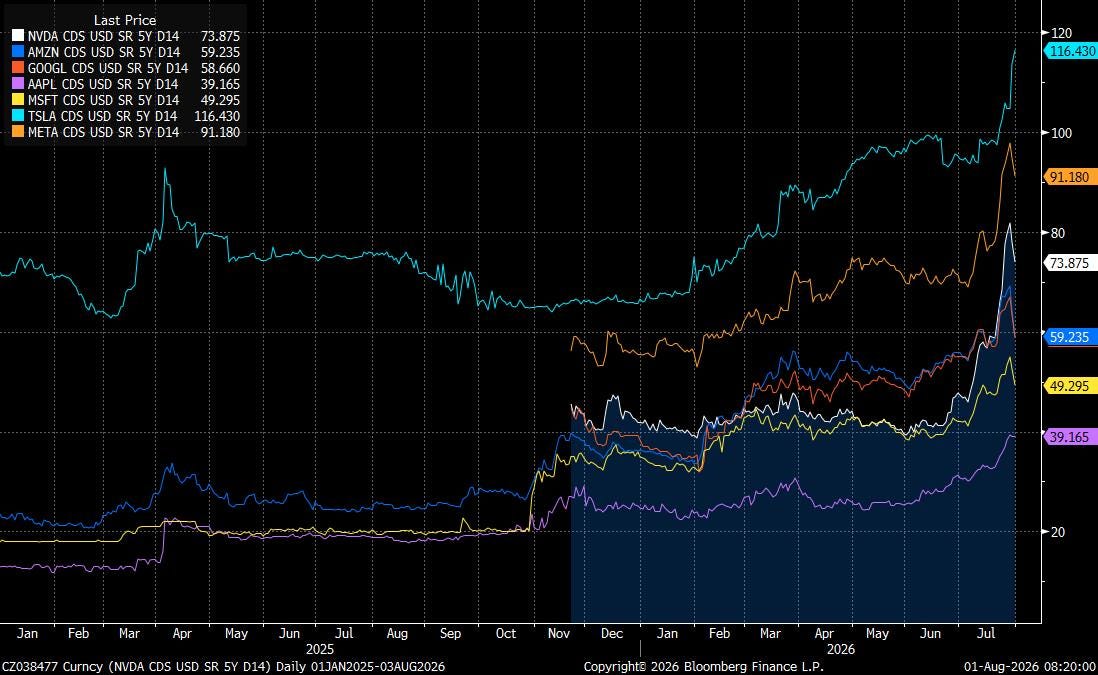
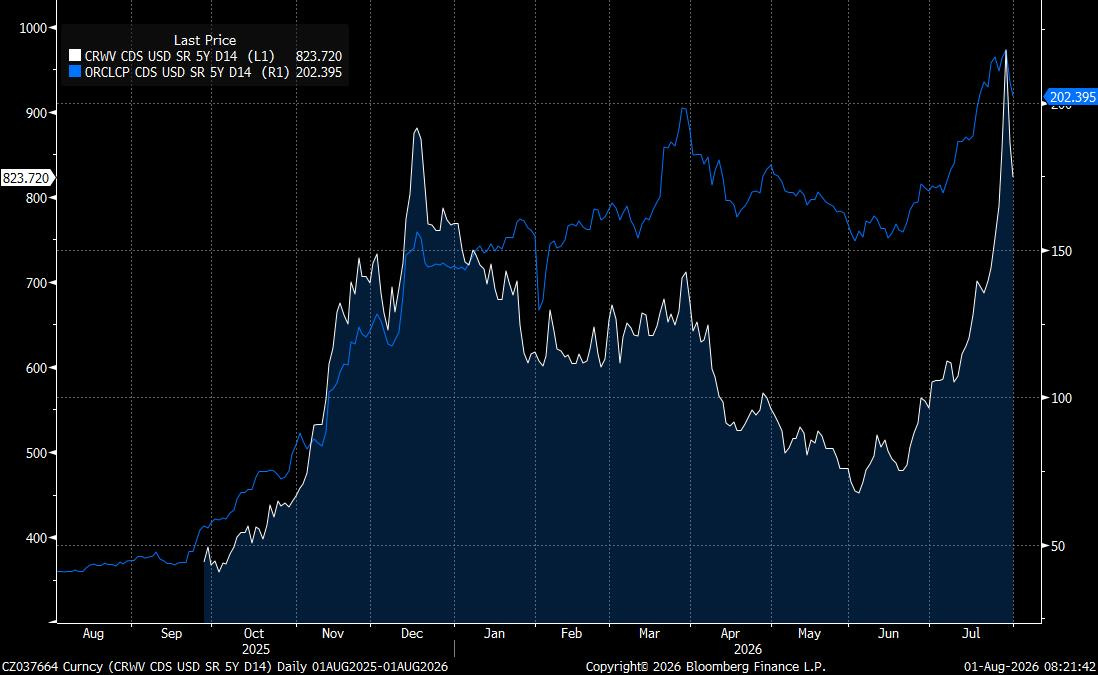
…but ORCL and CRWV need their own axis. ORCL CDS sits 90bps higher than its peers above.
Take-or-pay agreements may be described as cloud contracts, but economically they function much like credit. Providers commit billions upfront to data centres and GPUs against customers’ promises to purchase capacity over several years. The infrastructure becomes the collateral, and future revenue becomes the asset supporting today’s investment. That leads us to pose another new question:
Is AI demand growing quickly enough to justify the financial commitments already embedded in the system?
Financing can become strained even without an industry contracting. A data centre underwritten on expectations of 70% demand growth can disappoint if growth slows to 40%. Revenue may still be reaching records, the industry is certainly not contracting, but the assumptions supporting the financing change. That is the second-derivative problem.
If this sounds similar to the GFC, your connections would be correct. But this is a different market, but both rely on future growth validating commitments made in the present.
This point ties together the first two Cs we mentioned.
If more efficient models and cheaper Chinese alternatives reduce the amount of compute required per task or compress the economics of inference, it pressures the investment cycle. Ultimately, balance-sheets will determine who can absorb that adjustment.
This explains the spread that Coreweave and Oracle have over the other tech CDS. CoreWeave finances GPUs against contracted demand, and Oracle has become increasingly concentrated in AI infrastructure through debt financing and lower cash flow bases than the likes of MSFT, AMZN, and GOOGL.
So the first two Cs culminate to this. Credit will be the market’s first attempt to distinguish between the companies capable of funding the AI transition and surviving adjusting assumptions of monetisation.
A Clearing Event, Not an All-Clear
The above questions help us to navigate the AI trade in the medium- to long-term. What happened this week, however, can guide us in the short term.